FanGraphs Weekly Mailbag: August 1, 2026
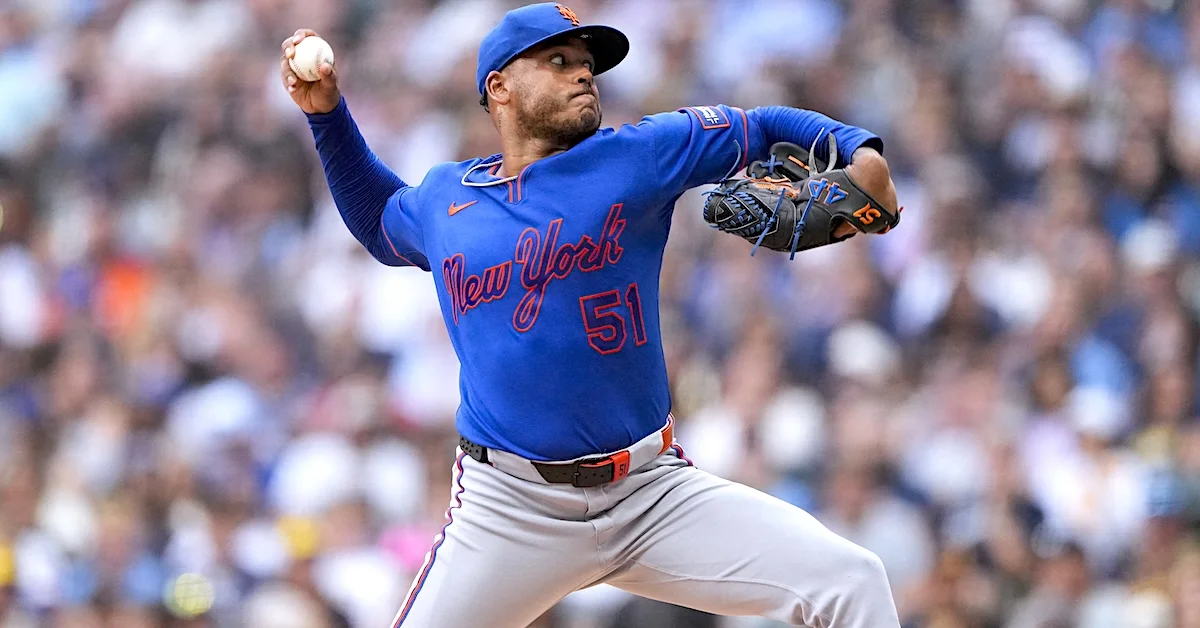
We’re less than three days away from the trade deadline, and aside from a challenge trade here and some minor swaps there, the only action we’re getting is inaction. Both Casey Mize of the Tigers and Freddy Peralta of the Mets were scratched from their scheduled starts Friday night, presumably as a precautionary measure to ensure that neither hurler would get hurt ahead of a likely trade.
Of course, we’ve known for a while that the Mets were going to be sellers this deadline season, giving their last-place standing for most of the year. They fired manager Carlos Mendoza at the end of June, and more recently, they’ve been giving every fan a $10 concessions voucher with their ticket, as both an apology for the poor performance on the field and an incentive to keep fans coming to the park to watch that poor performance — which in a few days could get even worse. In addition to Peralta, the Mets are also likely to at least some of their other pending free agents, such as Luis Robert Jr., Tyrone Taylor, Clay Holmes, and Brooks Raley 레일리, as well as high-leverage reliever Luke Weaver, who’s under contract through the end of next season. Detroit’s decision not to start Mize may have something to do with a groin issue that he’s been dealing with recently, as The Athletic’s Ken Rosenthal and Cody Stavenhagen noted. The team let Tarik Skubal, the top pending free agent on the block, start on Thursday even as it is supposedly shopping him. That’s because the Tigers still have about a 1-in-4 shot to make the playoffs, as of the start of play Friday, according to our Playoff Odds. They reportedly haven’t made a final decision on whether they will trade Skubal and their other players on expiring contracts, among them Mize and second baseman Gleyber Torres. If Detroit ends up selling, closer Kenley Jansen, who has a club option for next season, could also be on the move.
In addition to answering your questions about the trade deadline in this week’s Mailbag, we’ll also cover Jordan Hicks’ resurgence with the White Sox, home runs hit slower than the pitch that was thrown, and odd Hall of Fame cap decisions. But first, I’d like to remind you that this mailbag is exclusive to FanGraphs Members. If you aren’t yet a Member and would like to keep reading, you can sign up for a Membership here. It’s the best way to both experience the site and support our staff, and it comes with a bunch of other great benefits. Also, if you’d like to ask a question for an upcoming mailbag, send me an email at [email protected].
__
It seems like teams are less willing than ever to swing big deals for rental players. We hear over and over about how it’s not 2016 anymore, when Aroldis Chapman fetched the Yankees Gleyber Torres.
What are the most consequential rental trades to happen since then? (Or: How have rental trades evolved since then?) — Connor G. in San Francisco
Ben Clemens: One great thing about rental trades: There are a ton to analyze. By my count, there have been just over 700 trades that roughly count as “rentals” – players less than a year from free agency dealt at the trade deadline – since 2016. That encompasses everything from Manny Machado to the Dodgers in 2018 (one of the highest-impact trades on the list) to Cleveland trading Ross Detwiler to the A’s for cash in 2016. Machado was indeed the most impactful rental, as measured by rest-of-season WAR. But he moved for a relative pittance: five prospects headlined by a borderline top-100 guy (Yusniel Díaz) and Dean Kremer. A few years later, the Dodgers swung another deadline deal of note: rental Max Scherzer and 1 1/2 years of Trea Turner in exchange for Keibert Ruiz, Josiah Gray, and more. But that wasn’t a pure rental, and I’d assign the lion’s share of value in that deal to Turner rather than Scherzer, hence my giving Machado top billing.
If we look at recent years only to search for a trend in rental deals at the deadline, there are no blockbusters to speak of. The Mariners swapped two 40+ FV prospects for Josh Naylor last summer – our new prospect valuation method thinks that’s worth, at most, a fraction of a Gleyber Torres-level return. The prior year was slightly better; Yusei Kikuchi brought back a haul when the Blue Jays sent him to Houston. That return was Jake Bloss, who straddled the 45+/50 FV line at the time, Will Wagner (45 FV), and rotational outfielder Joey Loperfido.
Another fun recent-deadline fact: Chris Stratton has been involved in two of the most impactful rental trades of the past half decade. First, in 2022, the Pirates attached him and his 1 1/2 years of control to a deal that sent Jose Quintana to the Cardinals for the stretch run (return: Johan Oviedo and Malcom Nuñez). Then, at the next deadline, St. Louis traded Stratton and Jordan Montgomery (a rental as well) to the Astros for Tekoah Roby (50 FV), Thomas Saggese (45+), and reliever John King.
There just haven’t been many big-splash rental deals to speak of since that Chapman-for-Torres trade. That said, there are a few trades that are arguably outside the letter of the exercise, but that I still count in spirit. The Cubs rented Alex Avila and got multiple years of Justin Wilson in 2017, and sent Jeimer Candelario and Isaac Paredes back to the Tigers in the deal, though both turned out better than their pedigree at the time. The Mets sent Pete Crow-Armstrong, then a back-of-the-Top-100 type, to Chicago for Javier Báez plus multiple years of Trevor Williams, and that was seen as a huge return for the Cubs in the moment. The A’s dealt Jesús Luzardo, already a big leaguer but whose value was at a local low, to the Marlins in exchange for Starling Marte’s walk year. The Blue Jays acquired Teoscar Hernández from the Astros for a rental of Francisco Liriano.
I’d say that on the whole, rental trades are in about the same place they were in 2016. If you’ll remember, even at the time, the Chapman-for-Torres trade was considered an outlier, and that’s still about right. Interesting players get traded for rentals all the time. Particularly if a seller is dealing multiple rentals at once, or stapling a controllable reliever to a desirable free-agent-to-be, the return can involve top 100 prospects. But those are the exceptions rather than the rule, just as they were a decade ago.
__
Hi FanGraphs team,
Is Jordan Hicks… back? He’s not throwing 103 anymore, but it seems like the White Sox(!) have helped him stabilize.
Did they really fix him, and, if so, how did they fix him?
Thanks in advance,
MZ
Michael Baumann: Jordan Hicks! The original triple-digit-velo, pitch-to-contact guy. Hicks had everyone in baseball scratching their heads over why he couldn’t strike anyone out — this was before we talked about pitch shape the way we do now — but he had a nice run with the Cardinals and Blue Jays. Lots of groundballs, with a couple decent high-volume, medium-to-high-leverage seasons out of the bullpen.
Then the Giants tried to make him a starter and broke him. Less than halfway into a four-year contract, San Francisco used him as contract ballast in the Rafael Devers trade. When the Red Sox couldn’t fix him either, they flipped him to Chicago, tossing in a promising high-minors relief prospect, David Sandlin, to escape half of Hicks’ contract.
Six months later, Sandlin is back in the minors and Hicks has a 3.19 ERA, a 3.11 xERA, and a 3.43 FIP in 31 innings out of the White Sox bullpen. I don’t know if he’s in the circle of trust for manager Will Venable just yet. Hicks has pitched 11 times in July; on nine of those occasions he was out of the game in the seventh inning or earlier, and one of the two exceptions was a 12th-inning engagement that came after Venable had already used four bullpen arms.
But all of those appearances have been scoreless. Hicks spent a month on the IL with a lat strain earlier this season, and since his return, he hasn’t allowed a run. In 14 appearances, totaling 13 1/3 innings, Hicks has struck out 21 of the 50 batters he’s faced, issuing five walks and four hits, all singles.
Hicks is still running a 16.1% walk rate for the season, and this hot streak is only a month and a half old. So I want to be conservative about throwing around words like “fix.”
But there are a few changes you can see. Hicks has usually been a low-three-quarters arm slot guy, but there’s been quite a bit of variation since Statcast started pumping out arm slot angles.
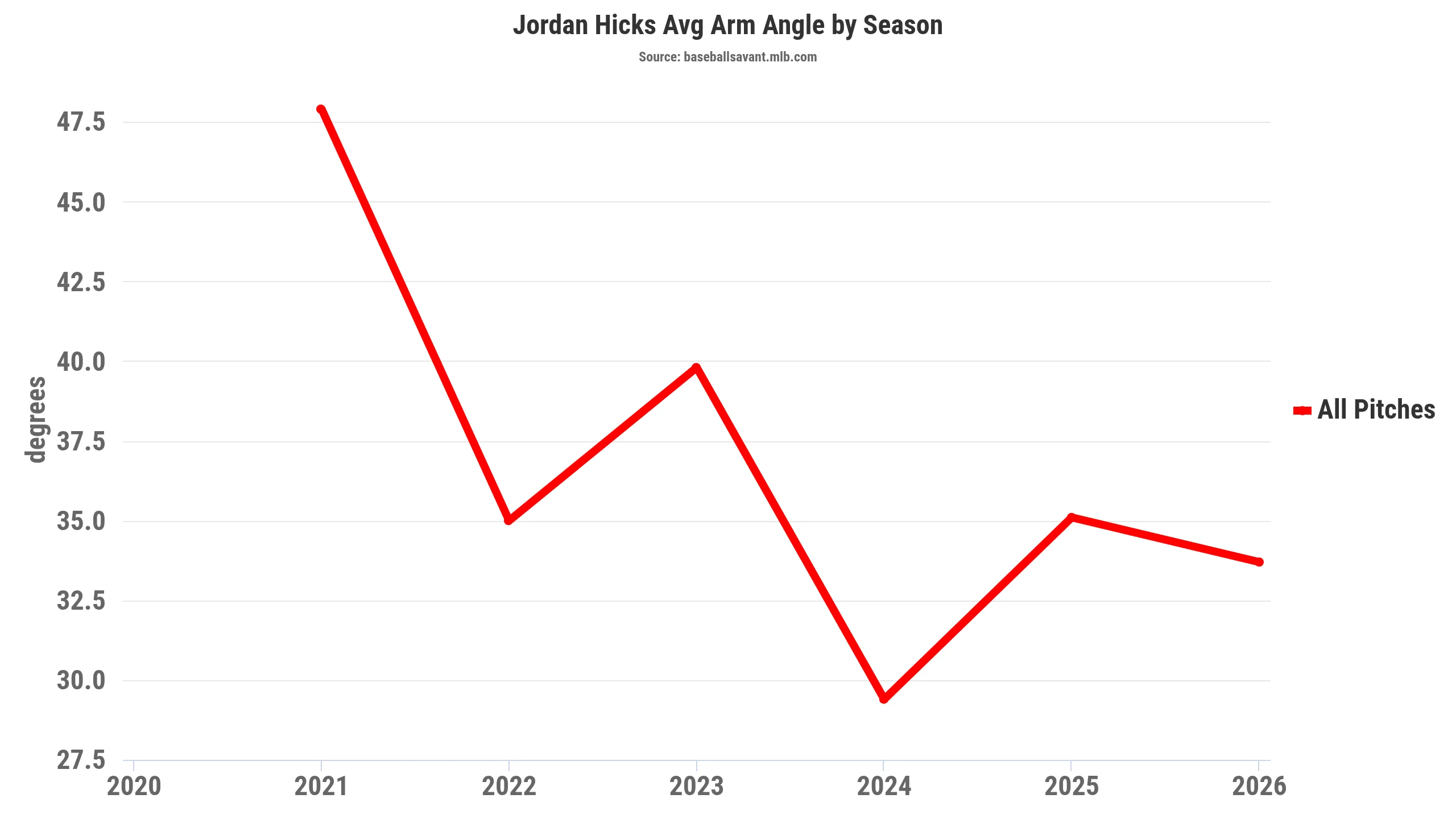
That graph makes it look like he’s dropped his arm slot in 2026, but if you look at it on a per-game basis, the opposite is true.
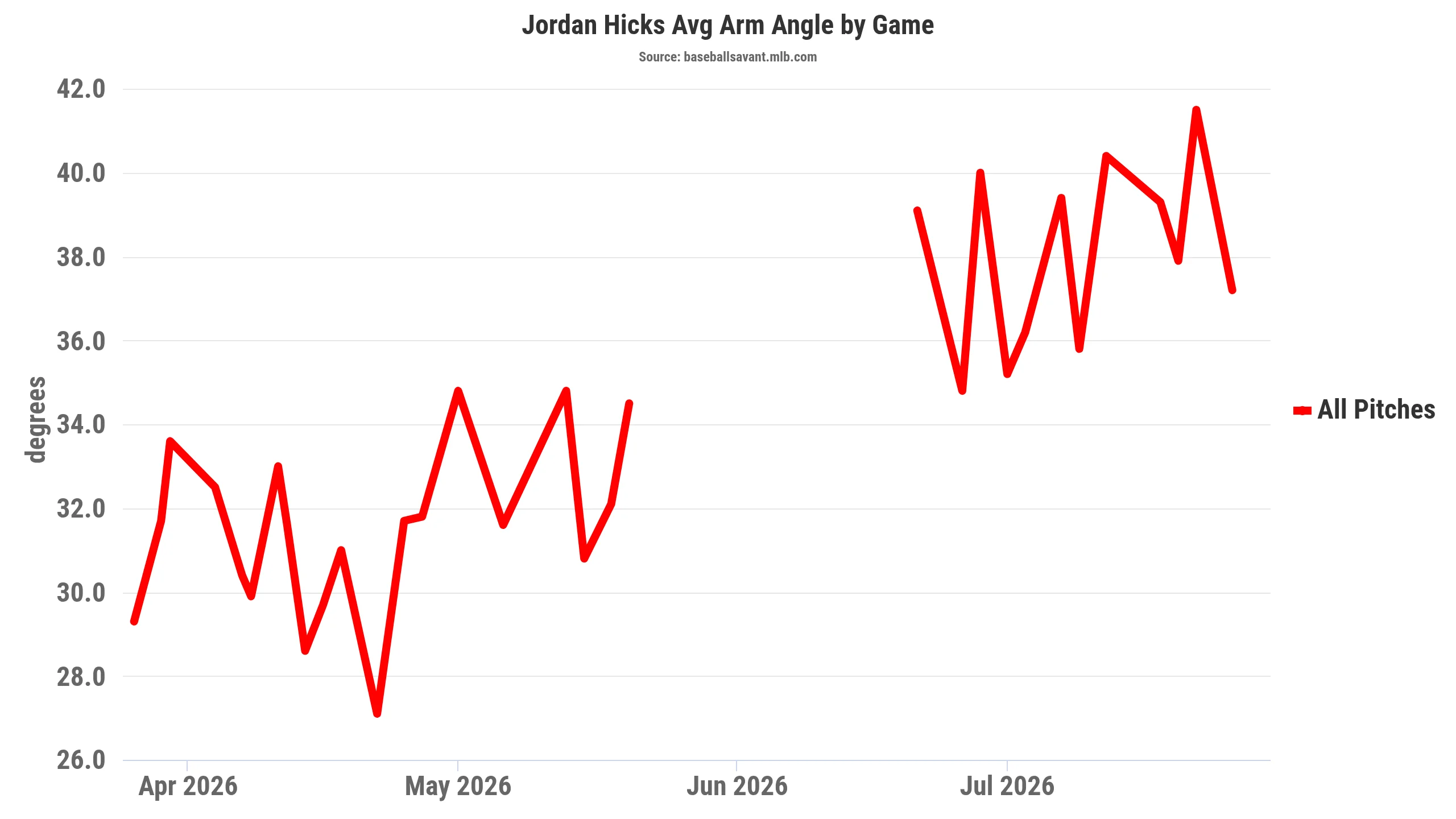
What effect has this had on Hicks? Well, there’s a reason I mentioned pitch shape earlier. Generally, how much a pitch breaks in absolute terms isn’t as important as what that break looks like relative to pitches of the same type, velocity, and release point. That’s why you get those Baseball Savant tables that measure a pitch’s movement against comparable or average pitches. If a pitch has normal movement, it won’t fool hitters. If you hear the phrase “dead zone fastball,” that’s what this means, and it’s why Hicks never struck anyone out early in his career. With his hard sinker, he was able to get guys to bang the ball into the ground with some regularity, but he struggled to miss bats altogether.
There are two big changes to Hicks’ game this year. First: He’s throwing more four-seamers than ever. His previous career high for four-seamer usage was 11%, in 2023, his last good season before this one. This season, Hicks is throwing 12.5% four-seamers, and since he came off the IL, that number is up to 25.5%. He’s also getting more relative arm-side run on his four-seamer, which brings it in line with his sinker when it comes to horizontal movement. No doubt that’s helping those two pitches tunnel better.
The other change is his sweeper. Hicks was throwing his sweeper in the low 80s for the past two seasons. This year, it’s up to 87.1 mph, which is the highest average velocity of his career. The last time it was anywhere near this fast was, you guessed it, 2023.
I don’t think Hicks has gone back to his old sweeper as such; the spin rate is down by a couple hundred rpm from 2023, for instance. More to the point, he’s cut six inches of horizontal movement off the sweeper since that year. That sounds bad, but remember: This is about differentiating the pitch from the batter’s expectation. Hicks is now throwing a four-seamer with almost five inches of surplus arm-side movement and a sweeper with five inches less glove-side movement than expected.
Is this sustainable? Will batters adjust? Will Hicks ride this renaissance to a high-leverage role as the White Sox bear down on the playoffs?
No idea. But he’s definitely pitching differently than he was for the past two years.
__
Hello Mailbag!
Cole Carrigg hit an interesting homer the other day off Jacob Misiorowski (not just because hitting anything off him is impressive).
Miz’s pitch was 101.9 mph, while Carrigg’s exit velo was only 98.2 mph.
Two questions:
1) How rare is it for a non-inside-the-park home run to have a slower exit velo than the pitch?
2) What is the biggest negative velo gap between a pitch and a home run?
Thanks!
Eric
Davy Andrews: Hello Eric. I am Mailbag and I love this question. I have been chewing on it all week. It is delicious. Allow me to spit out some answers for you. I am Mailbag and this is my purpose.
Before I dig into the numbers, please understand that although I did my best to weed out inside-the-park home runs, I probably missed a handful. I am doing my best here. I am just a bag of mail and I have no hands.
Such home runs are rare, but not as rare as you might suppose. Over the course of the Statcast era, we have seen 531 home runs that left the hand at a greater velocity than the bat. They are slower homers, so we call them slowmers. I am Mailbag and this is the kind of joke that I make. Slowmers make up 0.84% of all home runs. They happen roughly once every 50.5 games. So on a given Saturday in September, with all 30 teams playing and two doubleheaders to make up for rain delays earlier in the season, you’ve got a one-in-three chance of seeing a slowmer (provided you are watching all 17 games, of course; I am Mailbag and I have no eyes).
The softest over-the-fence home run in the Statcast era came off the bat of Harold Ramírez, who in 2022 pulled a 90-mph Nestor Cortes cutter 323 feet down the line at the Trop at a recorded exit velocity of 85.4 mph. You didn’t ask me about that, but I thought you might want to know anyway. It was an amuse-bouche to get your mouth watering and make the answer to your question that much tastier. I am Mailbag and I do have a mouth. It’s where Matt Martell gently deposits my correspondence and then, on Friday afternoon, retrieves my responses.
(Editor’s note: I do what to your mouth?)
The biggest velocity gap belongs to Brandon Belt, who, on August 20, 2023, turned around a 99.4-mph fastball from Hunter Greene for an 87.6-mph home run. That’s a difference of 11.8 mph. It’s the slowmest of slowmers. It bounced off the top of the wall, then off the coconut of a Blue Jays fan in the front row, and landed back in the playing field. Luckily for the fan, the ball must have been traveling slowly indeed by the time it clocked him in the bucket hat.
As you’d expect when dealing with the biggest outlier of the past 12 seasons, it was an odd home run. Greene busted Belt with a high fastball, not just inside, but a good two inches off the plate. With that velocity and in that location, a pitch should be borderline impossible to turn on, but somehow, the 35-year-old Belt did it, mostly. He was just a little bit tied up, catching the ball somewhat closer to the trademark than the barrel. Normally, a ball hit in such a manner ends up snugly in a glove somewhere in right-center field, but a number of factors altered this one’s trajectory.
Because the pitch was so, so far inside, Belt’s bat had to be way, way out in front of him, which allowed him to pull it down the line to the shortest part of the ballpark, even though he didn’t get all the way around on it. (Had he gotten all the way around on it, he surely would have pulled it foul.) Because that ballpark was Great American Ballpark, where the ball really flies and the fences stand approximately nine feet past the infield dirt, it didn’t have to travel more than 344 feet. And because it was an 88-degree day in Cincinnati with a southwesterly wind that pushed the ball not just out, but further into the corner where the fence is shallowest, the ball was flying under optimal conditions.
The weirdest part of the whole play, though, is that Belt knew it was gone all the way. It was the ultimate slowmer, the 20th-slowest home run in recorded history, but he dropped his bat and trotted out of the box like he didn’t have a doubt in the world that he’d just gone yard. Fly balls hit between 87 and 88 mph get caught 97.9% of the time. They turn into home runs 0.1% of the time. I can’t decide whether Belt was delusional or whether he just had a preternatural sense of what it took to get the ball over the wall. I am Mailbag and I cannot see into the hearts of men.
Fun Mail Fact: Belt also homered off a Greene fastball the next time he came up. That homer left the bat going 17.6 mph harder than the first one, but Belt didn’t stop to admire it. It was also a low line drive. It was a fastball at the bottom of the zone, and it left the bat looking for all the world like a sliced five iron. It cleared the left field fence by about three feet, which is to say, three feet more than the first homer.
I am Mailbag and this was a longer answer than I anticipated. I feel weary. I must rest for a week.
__
Carlos Beltrán had some really nice remarks about choosing to have the Mets cap on his Hall of Fame plaque during his induction speech. Most cap decisions seem to make sense. Who is the Hall of Famer with the most surprising cap on his plaque? — Justin
Jay Jaffe: That’s a good question. First off, I thought the part about Beltrán’s cap choice was one of the most interesting in his entire speech. Here’s the excerpt from the speech that I included in my Induction Weekend rundown:
“Every organization shapes your career. New York shaped my life. It was here where I experienced my greatest success and some of my greatest challenges. Playing for the Mets made me a better man and a better leader. Many of the most meaningful relationships that I was able to build in my career, I did it wearing a Mets uniform. So the Mets cap, what it represents to me is growth and it represents a place where I became the best version of myself.”
The choice of caps is generally an interesting post-election sidelight even if it’s often obvious; that Beltrán chose the Mets, Andruw Jones the Braves, and Jeff Kent the Giants wasn’t exactly shocking, as each player spent the longest and best stretches of his respective career with those teams. But not every player has such an easy decision, and while honorees do have input over which team they represent on their plaques, the Hall has the final say. The institution clarified its stance in 2001 in the wake of a New York Post report that Dave Winfield negotiated with both the Padres and Yankees and received a financial package of $1 million over his choice of San Diego. Winfield denied such an arrangement, calling it “the worst of tabloid journalism.” That he might have represented the Yankees seems rather incongruous given that owner George Steinbrenner so regretted signing Winfield to a 10-year deal that he paid gambler Howard Spira $40,000 to dig up dirt on the slugger, action that resulted in the Boss receiving a lifetime ban from the game in 1990, though he was later reinstated. At the time of the Winfield cap flap, ESPN’s Darren Rovell reported that Wade Boggs — then a presumptive 2005 first-ballot honoree thanks to his 3,010 hits and five batting titles — had a contractual clause to represent the Devil Rays, but that proved false as well. He wears a Red Sox cap on his plaque.
Reflecting the reality that the advent of free agency has increased player movement among Hall of Famers, in 2014 the institution began giving players and managers the option to choose blank caps if they made significant impacts with multiple franchises. While the Hall had used blank caps for dozens of old-timers who played in the days before cap lettering and logos were common, Johnny Mize, Yogi Berra, and Catfish Hunter were the only post-World War II honorees with blanks up to that point. (Berra’s plaque shows him at such an angle that a logo wouldn’t be visible.) Since then, Tony La Russa (inducted in 2014), Greg Maddux (2014), Roy Halladay (2019), Mike Mussina (2019), Fred McGriff (2023), and Jim Leyland (2024) have gone the blank route, and earlier this year, the Hall updated 2010 inductee Andre Dawson’s plaque to a blank as well. Against his wishes, Dawson previously wore the Montreal Expos’ M on his plaque instead of the Cubs’ C, and while he would have preferred a switch to the latter, the blank proved an acceptable compromise. Not counting executives, there are 68 Hall of Famers with no logos on their caps, far more than for any individual team.
With that prologue, I think I have a pretty good answer to your question: Willie Keeler. In a 19-year playing career during which he racked up 2,932 hits and finished with a lifetime batting average of .341, Keeler played the most games with the New York Highlanders (now the Yankees) — 873 from 1903–09 — but is most famous for his 1894–98 run with the powerhouse Baltimore Orioles (1894-98), with whom he won three pennants and two batting titles while playing alongside fellow Hall of Famers such as Dan Brouthers, Hughie Jennings, Joe Kelley, John McGraw, and Wilbert Robinson.
| Team | Seasons | G | H | AG | OBP | SLG | OPS+ | bWAR |
|---|---|---|---|---|---|---|---|---|
| New York Highlanders (Yankees) | 1903–09 | 873 | 974 | .294 | .347 | .341 | 111 | 11.9 |
| Baltimore Orioles | 1894–98 | 644 | 1097 | .388 | .434 | .492 | 139 | 26.3 |
| Brooklyn Superbas (Dodgers) | 1893, 1899-1902 | 566 | 833 | .352 | .389 | .425 | 129 | 16.2 |
| New York Giants | 1892–93, 1910 | 40 | 28 | .322 | .404 | .437 | 144 | 0.8 |
Keeler had the most hits and bWAR with the Orioles. Yet on his plaque, his likeness is adorned with a cap featuring a Brooklyn Dodgers logo, reflecting the franchise with whom he had his third-highest total of games played, though he did accrue more bWAR with Brooklyn than with the Highlanders.
The choice for Keeler’s cap — which had no input from him, as he died in 1923, 13 years before the first Hall elections and 16 years before the institution’s physical opening — gets a bit stranger when you realize that the logo is that of the 1912 team, with a sans serif B inside a diamond. During Keeler’s Brooklyn days, the team was known as the Superbas, and had either a blank cap or a slab serif B, with a gothic B on the uniform itself. The explanation is that Keeler served as a coach for the Dodgers from 1912–14, and the Hall chose to immortalize him wearing a cap from the first of those seasons. By the last year of that stint, Robinson’s first of 18 as the manager, the team was generally known as the Brooklyn Robins, and adopted the more familiar B with the rounded loops and the triangle cutout, a style that Todd Radom, the game’s foremost graphic designer and branding expert, describes as Tuscan.
While Keeler is my answer for the most surprising choice, I can offer a few others of note. Radom is the author of the recently published book The Ballpark and Beyond: An Illustrated History of Baseball’s Rich History, a gorgeous full-color book in which he pulls double duty as both a visual artist and writer. In a chapter on Hall plaques, Radom mentions the idiosyncratic choice for Keeler’s visage, and writes of Jim Thome’s choice:
Slugger Jim Thome’s plaque features the Cleveland Indians’ “block C” logo, which he wore for just a handful of games during his final season in 2011. Thome spent 13 of his 22 seasons in a Cleveland uniform, and his induction took place in the summer of 2018, shortly after the team announced that it was discontinuing the use of its polarizing Chief Wahoo logo, which Thome wanted no part of. “I know my decision would be to wear the ‘C’ because I think it’s the right thing to do,” he told the media after an event in Cleveland that February. “I think I need to have a conversation with the Hall of Fame because of all the history and everything involved. I just think that’s the right thing to do.”
When I reached out to some pals with whom I annually spend time in Cooperstown, The Athletic’s Tyler Kepner chimed in by noting that Jimmie Foxx and Lefty Grove both wear Red Sox caps instead of A’s caps despite their stints in Boston being shorter and less distinctive than those in Philadelphia. Foxx played 11 seasons with the A’s, during which he collected 1,492 hits, 302 home runs, two MVP awards, and 61.2 bWAR while playing for the team’s 1929 and ’30 champions and ’31 pennant winners. By comparison, he played seven seasons in Boston, with 1,051 hits, 222 homers, one MVP award, 31.8 bWAR… and zero pennants. The breakdown is similar for Grove, who went 195-79 with a 2.88 ERA (151 ERA+), an MVP award, and 64.9 bWAR in nine seasons in Philadelphia (including that same 1929–31 postseason run), and 105-62 with a 3.34 ERA (143 ERA+) and 41.9 WAR in eight pennant-free seasons in Boston.
There aren’t any concrete reasons that I could track down as to why they both chose a Red Sox cap. The A’s didn’t have a cap logo for some of the years Foxx and Grove played with them; based on the images in the Dressed to the Nines uniform database, a digitization adaptation of Marc Okkonen’s groundbreaking book, Baseball Uniforms of the 20th Century: The Official Major League Baseball Guide, the team’s first year with a logo was 1929. But the choice may have been fueled by resentment that Connie Mack broke up such a juggernaut; Mickey Cochrane, another core member of those 1929-31 A’s, went with a Tigers logo, though to be fair, he managed them to back-to-back pennants in 1934-35 with a championship in the first of those years.
Former mayor of Cooperstown Jeff Katz, my perennial host for Hall of Fame Induction Weekends and the author of Split Season 1981: Fernandomania, the Bronx Zoo, and the Strike That Saved Baseball, offered up Nolan Ryan wearing a Rangers cap. Ryan spent only his final five seasons — out of a record 27 — with the Rangers, compared to nine with the Astros, eight with the Angels (where he racked up by far the most wins, strikeouts, no-hitters, and WAR of his career), and five with the Mets. He’s a Texas native who collected his 300th win and his sixth and seventh no-hitters for the Rangers, and as Rovell noted in 2001, “a consulting contract with the team [at the time of his induction] probably helped eliminate the Astros, Angels and Mets.” Ryan eventually strengthened those ties to the franchise, serving as the team president and CEO from 2008–13.
As with debates over who should be in the Hall itself, it’s easy to fall down a rabbit hole when it comes to the cap choices on plaques. Now, if only we could figure out which one 2027 candidate Buster Posey will wear…