FanGraphs Weekly Mailbag: September 19, 2026
The most exciting story as we approach the final week of the regular season is, at least by my accounting, the race for first place in the American League Central. On one side, we have the Chicago White Sox, a team that two years ago broke the modern record for the most losses in a season. Their outlook entering this season reflected their recent history. On Opening Day, Chicago had the worst playoff odds in the AL, with a 1.2% chance of making the playoffs, a 0.6% chance of winning the division, and a 0.1% chance of securing a first-round bye. And yet: The White Sox held at least a share of the division lead for 96 days this year, including a 73-day stretch from the start of play on July 5 until the end of the day Wednesday, when the Cleveland Guardians won the rubber match of a three-game set against the South Siders.
Unlike Chicago, Cleveland has seven playoff berths, including six division titles, in the past 10 years. The Guardians are winning the same way they always do, with excellent pitching, defense, and baserunning. Now, their lineup is deeper than it’s been at any point in the 2020s, though it’s still not exactly good.
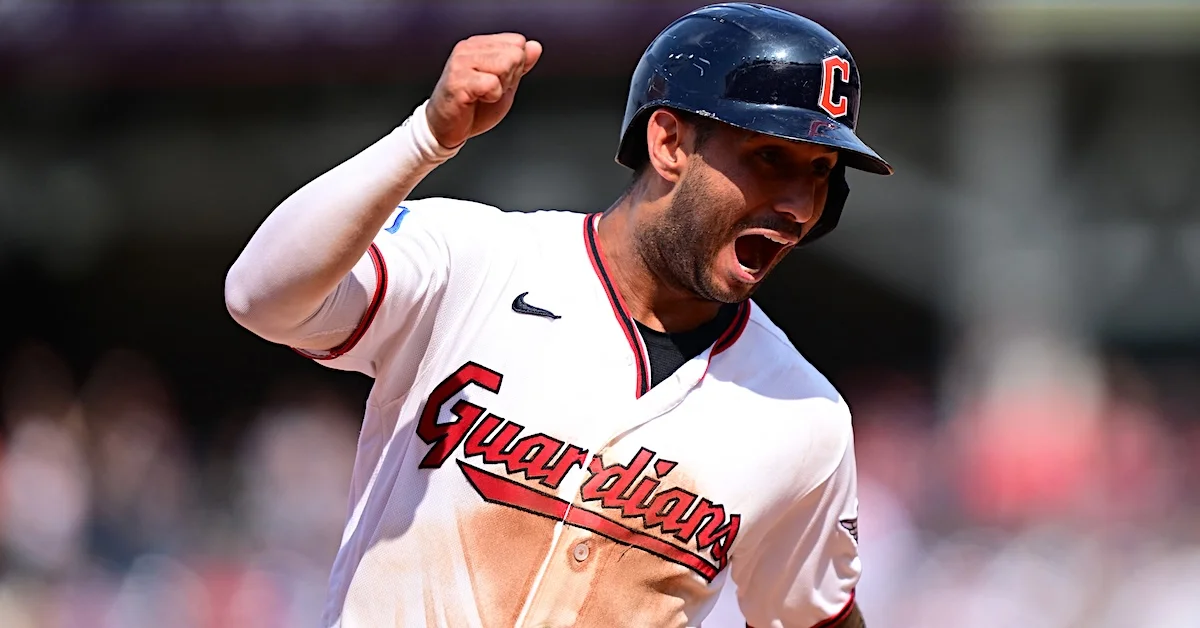
In Wednesday’s game, the Sox had a one-run lead over the Guards, who were batting in the bottom of the sixth with a runner on first, two out, and Austin Hedges — he of the lifetime 54 wRC+ — at the plate against the left-handed Hagen Smith, who had relieved lefty starter Anthony Kay the previous inning. Hedges walked, prompting White Sox manager Will Venable to replace Smith with yet another lefty, Sean Newcomb. Up next for Cleveland was backup center fielder Petey Halpin, a left-handed hitter who was in the lineup for the injured lefty killer Angel Martínez. Halpin entered the game 1-for-35 on the season against southpaws, and though he did record a single in his first at-bat against Kay, what happened next still ranks among the most unexpected events of the 2026 campaign. Facing a 3-1 count, Halpin turned on a belt-high sinker and launched a no-doubt three-run homer to put the Guardians on top for good.
After an off day Thursday, Cleveland began a three-game series at home against the Athletics on Friday, while Chicago played the second of its four-game set against Detroit. As of Friday afternoon, our Playoff Odds gave the Sox a 50.9% chance to win the division and an 80.3% shot to make the postseason; for the Guards, those odds were, respectively, 49.1% and 77.0%.
We’ll talk a little bit more about the Guardians in this week’s mailbag, when we answer a question about shortstop Brayan Rocchio. We’ll also discuss a bonkers idea to get rid of batting lineups and the shortest season-long winning streak for a team that finished with the best record in baseball. But first, I’d like to remind you that this mailbag is exclusive to FanGraphs Members. If you aren’t yet a Member and would like to keep reading, you can sign up for a Membership here. It’s the best way to both experience the site and support our staff, and it comes with a bunch of other great benefits. Also, if you’d like to ask a question for an upcoming mailbag, send me an email at [email protected].
__
Dear FanGraphs team,
Brayan Rocchio’s clutch gene has become the stuff of legends among us Cleveland fans. I’ve seen the stat going around that, as of Friday morning, he has seven career walk-offs — in 1,476 career plate appearances, while tallying 4.2 career WAR.
Where does his 1.67 walk-offs-to-WAR ratio stack up in the history of the league?
Thanks for the consideration,
Kevin
Jon Becker: Hey Kevin, great question. It feels like all seven of Rocchio’s walk-offs have come in the last three weeks (it’s really just four this year) — that’s how timely he’s been lately despite the fairly unimpressive career, though he’s having a nice mini-breakout this season.
Now, onto your question. Rocchio is in a not-very-exclusive club of 1,437 batters with at least career five walk-offs; I restricted myself to those players so not every Joe Random with a single walk-off would muddy up the numbers. His 1.67 walk-offs-to-WAR ratio is pretty high up on the list, ranking 109th. But that ratio pales in comparison to the luminaries whose ratios are at least 10 walk-offs per WAR.
| Player | Walk-Offs | WAR | First Walk-Off | Last Walk-Off | Ratio |
|---|---|---|---|---|---|
| Al Spohrer | 8 | 0.01 | 5/14/1929 | 7/28/1935 | 1573.73 |
| Jeff Hamilton | 5 | 0.07 | 8/22/1986 | 9/16/1991 | 74.38 |
| Miguel Ojeda | 5 | 0.20 | 7/21/2003 | 4/23/2006 | 25.52 |
| Charlie Hargreaves | 6 | 0.26 | 5/23/1925 | 6/29/1926 | 22.91 |
| Dioner Navarro | 8 | 0.45 | 8/12/2005 | 7/7/2013 | 17.96 |
| Eric Anthony | 5 | 0.30 | 5/21/1990 | 6/2/1993 | 16.43 |
| Bob Aspromonte | 16 | 1.14 | 5/5/1960 | 9/25/1971 | 14.00 |
| Bob Kennedy | 9 | 0.66 | 6/20/1940 | 8/16/1955 | 13.72 |
| Gerald Perry | 6 | 0.50 | 7/31/1985 | 6/28/1992 | 12.07 |
| Bud Clancy | 5 | 0.44 | 5/1/1927 | 6/5/1934 | 11.47 |
| Jim Holt | 5 | 0.47 | 8/7/1970 | 4/21/1973 | 10.58 |
| Biff Pocoroba | 5 | 0.49 | 5/17/1977 | 6/30/1982 | 10.21 |
I’ve heard of a lot of baseball players, including most of the ones on this list. I had never heard of Al Spohrer, whose last big league game was in 1935 and who died in 1972. His career was nothing notable in raw value, as you can plainly see by the WAR, but goodness gracious, was he often in the right place at the right time to deliver and absolutely destroy the field on this list.
The ratio methodology doesn’t account for negative-WAR players; technically, any player with a negative career WAR with even one walk-off has a better ratio than Spohrer, if you think about it. I’d like to give an honorable mention, then, to Kurt Bevacqua (who absolutely popped off in the 1984 World Series for the Padres, by the way). Bevacqua played parts of 15 seasons and retired with -2.8 WAR. He is the only negative-WAR player with double-digit walk-offs; he finished his career with exactly 10.
__
Last week’s DH question gave me an excuse to bring up my best baseball idea.
Along with separating offense from defense, what if we got rid of batting lineups?
Each team selects nine hitters for that day, but the manager can deploy them however they want with the only caveat being no hitter can hit n+1 times until the other eight have hit n times.
So, the manager sends up a couple high-OBP hitters to lead the game off. If one or both gets on, the manager sends up the sluggers to try to drive them in. If they both get out, the manager sends up the worst batter with two out and no one on.
If that batter gets on, then the manager has a decision. How good of a hitter do you they want to bring up in a low run-probability plate appearance?
Some patterns will definitely emerge, but managers are going to have to be making decisions all the time, giving fans endless things to criticize and second guess.
This seems like the best idea ever.
Why does everyone hate it?
— JuanUribeJazzHands
Michael Baumann: Every so often — and it doesn’t happen much — we get a mailbag question that leaves me with little or nothing to add. I am in awe, my friend. Bravo.
The key here is requiring everyone to get a turn before you restart the lineup. Without that rule, you’d get (throws dart at the standings) the Royals just running Bobby Witt Jr. out there until he reaches, at which point it’s Jac Caglianone’s turn to hit, and if he reaches without driving in Witt, you call up Carter Jensen or Vinnie Pasquantino or Maikel Garcia… that would get old really quickly.
But making the manager go through all nine hitters (I’m not sure whether pinch-hitters or defensive subs are allowed under this proposal; if not, that’d be truly radical) preserves the incentive to create a lineup with depth.
Whenever I get a real bong rip of a hypothetical rule change like this, I find myself defaulting to the same response: It wouldn’t change the game as much as you’d think. And that’s probably true here.
Having given the matter some thought, I agree with the default tactics JUJH laid out: Lead off with high-OBP guys, wait until they reach base, then bring in your mashers to drive them in. Alternatively, I could see teams just frontloading their lineups to make sure their best hitters get as many turns as possible.
But these are the two default lineup modes now; the difference is, like JUJH says, you probably wouldn’t bring your no. 3 hitter to the plate with two outs and nobody on. Instead, you’d wait for a scenario in which he could cause more damage. And because you’d have to clear the bottom of the order before resetting, the no. 6 through no. 9 spots would probably look about how they do now. I don’t think that a lineup reshuffle would change roster construction too much on the offensive side, though it might be bad news for pitchers with extreme platoon splits.
I’d love to see managers have to fly by the seat of their pants like this. If anyone down in the comments figures out how to mod OOTP to make the game work like this, let me know. I’d love to try it out.
As interesting as this idea is, the question of why everyone hates it is even more fascinating.
Managers would hate it because it increases the amount of decisions they make that can be nitpicked by outsiders. Imagine if you had to be on top of every batting order decision — 40 of them a game — and every high-leverage out suddenly became your fault, even if the difference between Witt and Tyler Tolbert is nearly imperceptible over the course of a single plate appearance?
The first thing I thought about with this rule was a penalty shootout in soccer — every player remaining on the pitch is eligible to shoot in any order, but everyone has to take a turn before anyone gets a second go-around. (Which actually has happened before, if only once a decade or so.) In Euro 2012, Portugal and Spain went to penalties, and Portugal’s coach held Cristiano Ronaldo back to take the decisive penalty… only for Spain to win the shootout before Ronaldo got his turn. Imagine Yordan Alvarez or Aaron Judge got left on the bench in a situation like that. I’m sure their managers would hate nothing more.
Players would hate it because they love routine. They want to know what they have to do, and when, as far in advance as possible. Ballplayers’ inflexibility led to the overdetermination of bullpen usage for decades. If they had to go with the flow, they’d take to the streets in protest with a ferocity usually only displayed by French farmers.
But fans? Why would we hate it?
Because it violates one of the fundamental philosophical underpinnings of baseball, which is that everyone gets a turn. I’ve mentioned this before, but I learned Marx from a professor who was a huge Yankees fan. He said baseball — especially youth baseball — is the most egalitarian sport because you build a winning team not by having the best individual player, but by having your weakest players make fewer mistakes than your opponents’ weakest players.
A smart youth baseball coach will spend their time and effort getting the worst players on the team to make fewer errors and strike out less, rather than trying to squeeze the extra 1% out of the kid who’s going to play travel ball no matter what the coach does. That’s less true in the pros, but the principle still holds — just ask Mike Trout or Shohei Ohtani how many World Series they won while they were playing together.
In baseball, you can’t run iso for Jordan or LeBron. You can’t double-shift Connor McDavid. You can’t kill the clock by handing the ball to your Pro Bowl running back. Everyone gets a turn.
JUJH’s proposal doesn’t violate that tenet, but it challenges it. Draws attention to it the way one might draw attention to a pimple, or a mustard stain. Everyone would still get his turn, but now the manager would be singling out which players he believes can succeed in high-pressure situations, and which ones he doesn’t believe in. To some extent, that’s true with a fixed lineup, but it’s vulgar to do it so obviously.
As much as baseball fans love to complain about everything, anyone who loves the sport has come to believe, if only on a subconscious level, that everyone gets to hit. Reshuffling the lineup mid-game offends the sense of fairness and fatalism that’s baked into baseball, and that’s why fans would reject it as alien and threatening.
__
Hello Mailbag,
During the Brewers broadcast on Sunday, September 13, against the Reds, the announcers stated that the Brewers’ at-the-time winning streak of five games was tied for their longest of the season. They promptly lost on Sunday to keep that statistic true.
This seems remarkable to me that the team with the best record in the league has never won more than five games in a row. Assuming the Brewers maintain both this max winning streak and the league’s best record, would this be the shortest maximum winning streak by the team with the league’s best record?
— Blue Shoes
Davy Andrews: What a crunchy question this was, Blue Shoes! Answering it required many clickings on Matt Martell’s computer. Perhaps I should explain: I am Mailbag, and I do not have my own computer. When I find myself chewing on a particularly numbery question, I borrow Matt Martell’s laptop while he human sleeps. (I am Mailbag, and my species knows not sleep, which provides much time to answer tasty questions, but can sometimes make things lonely.) As a consequence, I must always know Matt Martell’s laptop and Stathead passwords. When he changes one of them, I must pass my day skulking and peering around corners until I see him type in the new one. Luckily for me, Matt Martell’s password security is nothing to write home about (MAIL HUMOR) and his peripheral vision is a mixed bag (BAG HUMOR).
As to your inquiry, a team could theoretically run a shorter streak than these Brewers. Based on the advanced mathematical formula 162 ÷ 3 = 54, I calculate that a team with very regular rhythms could win as many as 108 games – nearly always enough to be the winningest – without ever winning more than two in a row. Nonetheless, you are right that this is remarkable.
Dating back to 1901, the winningest teams’ longest streaks averaged 9.81 games. Only one team has ever achieved what the Brewers are on the precipice of achieving, but one could argue that they should still stand alone. In 2007, Boston and Cleveland tied for baseball’s best record at 96-66. Cleveland’s longest winning streak was eight games, but the Red Sox never won more than five in a row (though they did so on three separate occasions.) If you would like to see a spreadsheet that lists the longest streak of every winningest team, please follow this link.
Does the fact that the Red Sox didn’t have the best record in baseball outright mean that they don’t qualify for this particular title? Do the Brewers stand alone? I am Mailbag, and as I do not understand all your human ways or snorings, I will leave this thorny ontological question up to you and your sad shoes.