Two Huge Innings Catapult White Sox Into ALDS
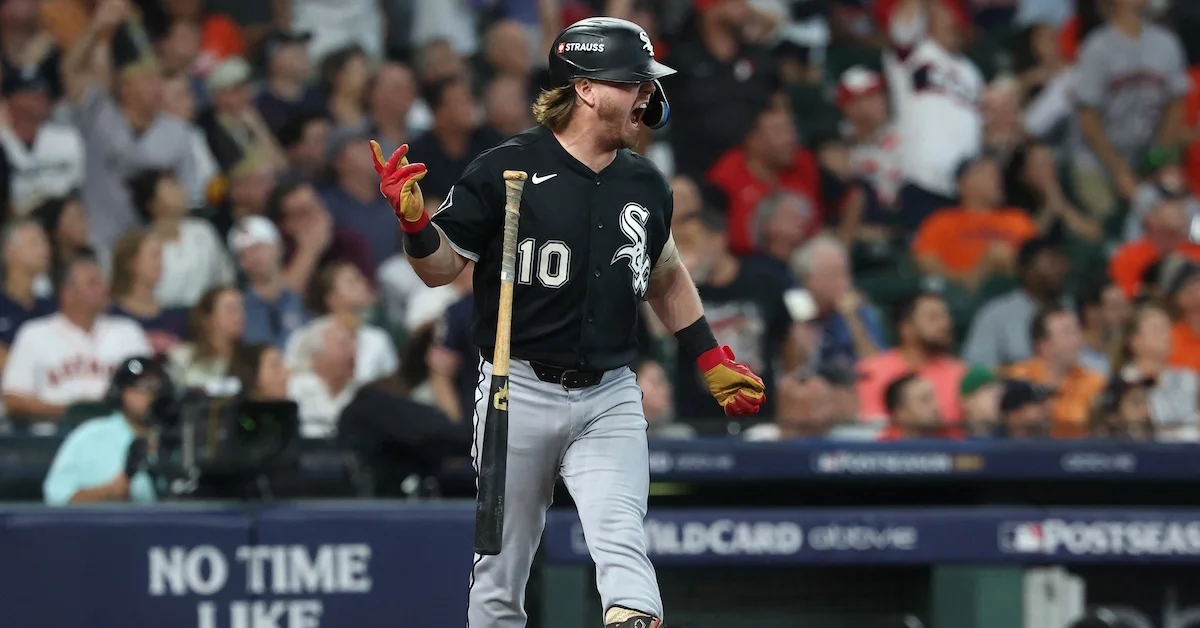
The fan bases with rooting interest in the White Sox-Astros Wild Card Series entered the postseason with differing perspectives on their teams’ relative talent and season quality. Chicagoans, though perhaps irked at how the division slipped away from them at the end of the season, were likely thrilled to be here after multiple consecutive 100-loss seasons. However, Houston fans, who have enjoyed a higher standard of living for the last decade, aren’t content with parallel parking into the top spot of a bad division, then bowing out in the Wild Card round. That was apparent during Houston’s Game 1 loss, which tasted sour enough to Astros fans that they let the kitchen know about it, and some of the players and manager Joe Espada acknowledged hearing it with varying levels of annoyance.
That set the tone for a mid-afternoon Game 2 at Daikin Park, in which the White Sox landed decisive blows in two big innings and sent Houston packing to win their first postseason series since they won the 2005 World Series. The Sox will now chart a Division Series course for Cleveland.
Within minutes of first pitch, this game looked as though it would be a blowout, as atypical changes to Houston’s lineup immediately backfired. Taylor Trammell, mired in a 1-for-32 slump, was replaced by infielder Nick Allen. That led to dominoes falling in such a way that usual DH and presumptive AL MVP, Yordan Alvarez, was tasked with playing the outfield for just the third time since the start of September. White Sox leadoff hitter Sam Antonacci tested Alvarez right away with a fly ball to the left-center gap. Alvarez’s route was too shallow, and the ball clanged off his glove as he tried to make an awkward play way up above his head. Antonacci was awarded a double and then scored on a Kyle Teel single. Houston’s first-inning gaffes continued as Allen, ordinarily a great defender but perhaps rusty from a lack of recent reps, booted a Miguel Vargas grounder. Two batters later, an Andrew Benintendi single was made worse when an errant throw by center fielder Lucas Spence allowed an extra run to score. First half hero Tristan Peters knocked an opposite-field single into left field to make it 4-0 within the blink of an eye.
Disastrous start for the Astros and the White Sox lead 1-0!
Yordan Alvarez drops one, RBI hit, Nick Allen error pic.twitter.com/VEEGO7nhb3
— Talkin' Baseball (@TalkinBaseball_) September 30, 2026
Astros starter Hunter Brown, who at his best looks like a Cy Young candidate, was shelled so badly in the first inning that he was removed before he could finish it. Brown faced nine hitters, threw 36 pitches, got just two outs, surrendered five hits, walked a guy, and threw a wild pitch. It was one of the worst starts of his career, with only an early-April 2024 stinker (nine earned runs in two-thirds of an inning) more implosive than this one. As disastrous a beginning as this was for Houston, Game 1 starter AJ Blubaugh (who himself failed to get out of the first inning on Tuesday) relieved Brown and got Antonacci to ground out, ending the inning and stranding the bases loaded.
It felt, as the game moved to the bottom of the first inning, as though the White Sox were simply going to bludgeon a taxed Astros pitching staff into oblivion. Houston needed seven different pitchers to get through Game 1 and was now going to need the bullpen to cover the final 8 1/3 innings of Game 2. Pretty quickly, however, Chicago’s leaving the bases loaded in the first seemed as though it might become consequential. White Sox starter Sean Burke hung a slider to Astros leadoff hitter Jeremy Peña, who crushed it 395 feet to left field to put Houston on the board. A few batters later, Jose Altuve followed with a well-struck, two-out single that might have been a pressure-inducing double in other ballparks, or if Antonacci had not collected the baseball so quickly as it caromed off the wall. Instead, Altuve held up and then was stranded at first.
Jeremy Peña hit a home run in the first inning!
Reply and tag @BudweiserUSA with #LeadoffBud for a chance to win a season's worth of beer. pic.twitter.com/0bkCxjVJV9
— MLB (@MLB) September 30, 2026
Peña’s blast was the first of three solo home runs that Burke, the All-Star, surrendered over the next four frames as Houston climbed back into the game. Those home runs, by Cam Smith in the second inning and Altuve in the fourth, were peppered throughout an otherwise excellent outing from Burke. He threw 72 pitches, 48 for strikes, and recorded eight strikeouts (including Alvarez twice) and zero walks. The lack of free passes (Burke threw first-pitch strikes to 12 of the 16 batters he faced) helped prevent Houston from posting crooked numbers. The homer by Altuve, once just a prospect nerd’s cult hero because of his lack of size, was the 28th postseason home run of his career, second all time and just one behind Manny Ramirez’s record of 29. Altuve’s October excellence, Houston’s consistently competitive team, and the changes in playoff format that created a greater number of postseason games, have all contributed to his ascent up the leaderboard.
JOSE ALTUVE MAKES IT A ONE-RUN GAME!
Jose Altuve has the 2nd most Postseason homers in MLB history with 28!pic.twitter.com/Hwk9CdiHwG
— FOX Sports: MLB (@MLBONFOX) September 30, 2026
After the Astros pulled within a run, White Sox manager Will Venable made a proactive move to his bullpen the same way he did in Game 1. Trade deadline acquisition Huascar Brazobán allowed two of the three hitters he faced to reach base — he plunked Smith and threw a middle-middle changeup to Peña that was laced to left field for a single — and suddenly the heart of Houston’s order, led by the terrifying Alvarez, was due up with just one out and the go-ahead run on base. Again, Venable made a change rather than let Brazobán to face Alvarez. Lefty Anthony Kay entered the fray.
Kay escaped, but it was an adventure. Alvarez flied out on a hard-hit ball to left field, then Kay loaded the bases on a four-pitch walk of Isaac Paredes. Finally, Altuve hit a well-struck fly ball to right that, off the bat, looked like it might be headed for the gap. Instead, it fell into the glove of right fielder Braden Montgomery for the third out.
This was as close as Houston got to breaking through. The White Sox hitters had gone quiet during the middle innings as Blubaugh redeemed himself with a scoreless inning and a third before giving way to Peter Lambert, who pitched three strong innings and was asked to go a fourth. Lambert walked the first two batters in the top of the sixth, prompting Espada to turn to Bryan Abreu, who threw just 11 pitches in a single inning of work in Game 1. Abreu fell behind 3-0 to Chase Meidroth and then laid a 3-1 slider right down the middle of the plate, which Meidroth put into the seats.
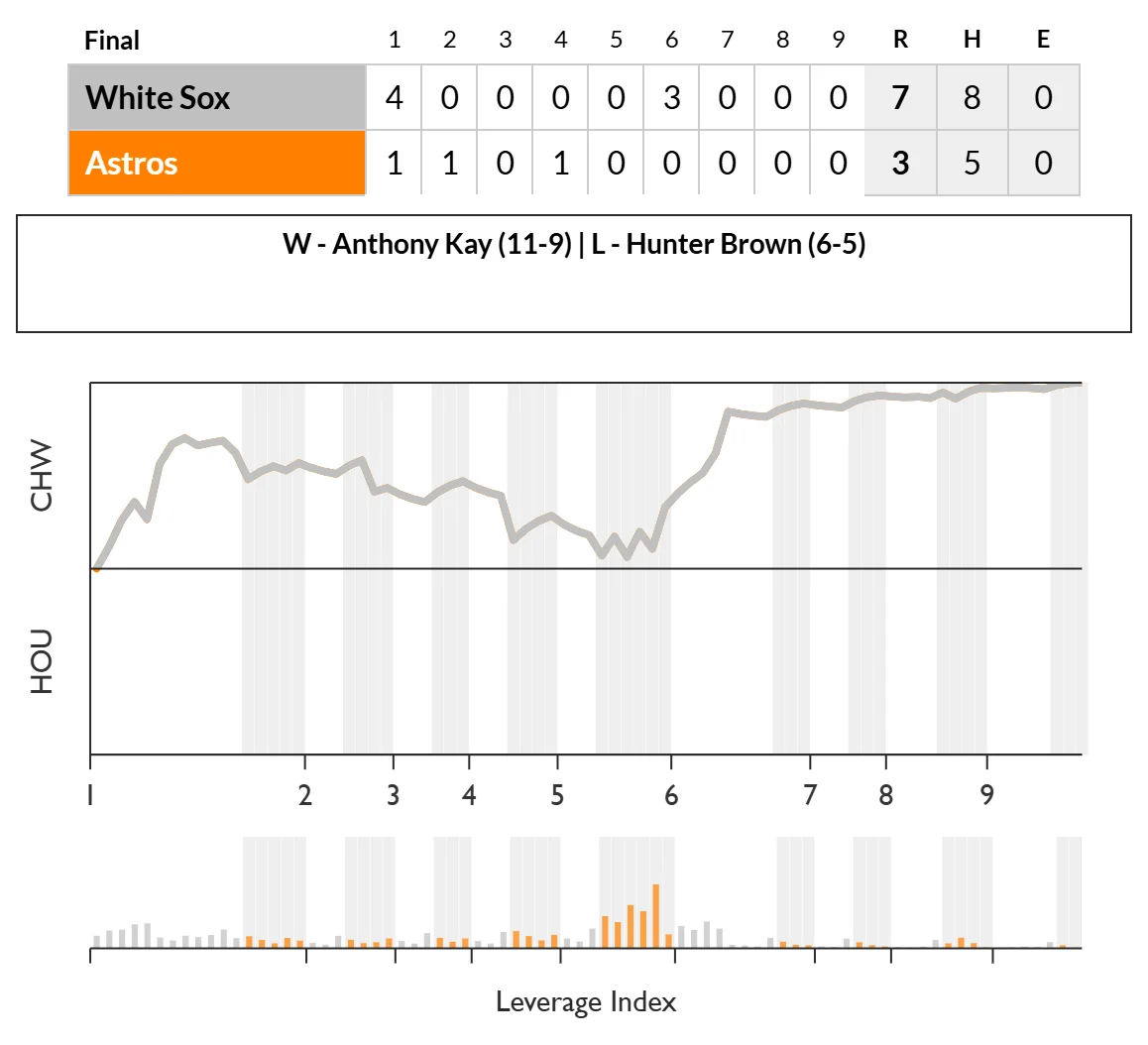
When Kay entered the game, the White Sox had a 55% win probability, per our simulation. About 10 minutes later, Meidroth’s homer had created enough room for the Sox to be 92% favorites. It was the first hit for a Chicago batter since Brown left the game. Abreu got the next three batters out and ended up striking out six over 2 2/3 innings; the lone hit he allowed was Meidroth’s homer.
Chicago’s bullpen clamped down for the final four innings. Fireballing reliever Jordan Hicks, who threw 17 pitches across 1 1/3 innings in Game 1, pitched two perfect innings (21 pitches) and was followed by swingman Erick Fedde, who worked two scoreless of his own to close things out.
Jordan Hicks is pumping gas ??
Touches 101.3 mph and works a clean 7th with 2 strikeouts.
6 outs separate Chicago from the ALDS. #WhiteSox pic.twitter.com/1Ob2cKwh0Q
— Adrian White (@AdrianWhiteSox) September 30, 2026
On top of being the franchise’s first postseason series win since 2005, it’s also the first for every player on the team aside from its glut of veteran outfielders: Benintendi, Tommy Pham, and Randal Grichuk. It’d be a notable achievement for any collection of players, but the White Sox have the 11th-youngest roster in baseball (only two other postseason clubs, Cleveland and Milwaukee, are younger) and were coming off of three consecutive 100-loss seasons. This is a mind-blowing turnaround that might signal the start of a prolonged window of contention for the Pale Hose. They’ll be greeted with a hero’s welcome by ravenous fans when they get to play a home playoff game next week. For now, they’ll head to Cleveland to face a rested and more-seasoned Guardians club. The Guards will have a Game 1 starting pitching advantage, assuming the matchup is Gavin Williams vs. Davis Martin.
Meanwhile, the Astros have the sixth-oldest roster, hired a new general manager during the summer, and could potentially lose some key cogs this offseason; Abreu, Daulton Varsho, and Steven Okert are all free agents, while Peña is entering his final arbitration season and could be a trade candidate. This just might be the end of an impressive era of sustained success, albeit one that included a reputation-altering scandal.