Fernando Tatis Jr. Went Turbo Mode
Major league baseball’s postseason derives its spine-tingling intrigue from many sources. There’s the tension — and inherent cruelty — of a months-long season coming down to a handful of games. Perhaps nothing in sports is better than a tightly-contested postseason game entering its final innings, the score so close and the stakes so high that it’s impossible to look away, while also leaving even the most devoted fans wondering if they can bear to watch. From these theatrics we often get epic performances and precise execution. Cam Schlittler dismantling the Red Sox with coiling curveballs and unfair fastballs in front of a bloodthirsty Yankee Stadium crowd, for instance. Grant Taylor’s dastardly 3-2 slider to strike out the potential tying run and end the eighth inning in Tuesday’s Game 1 against the Astros also comes to mind, as does the Braves’ note-perfect double play to squash the Phillies’ ninth-inning rally in their opening round first game.
But sometimes, well, sometimes a similar type of joy comes from the baseball equivalent of a windmill dunk.
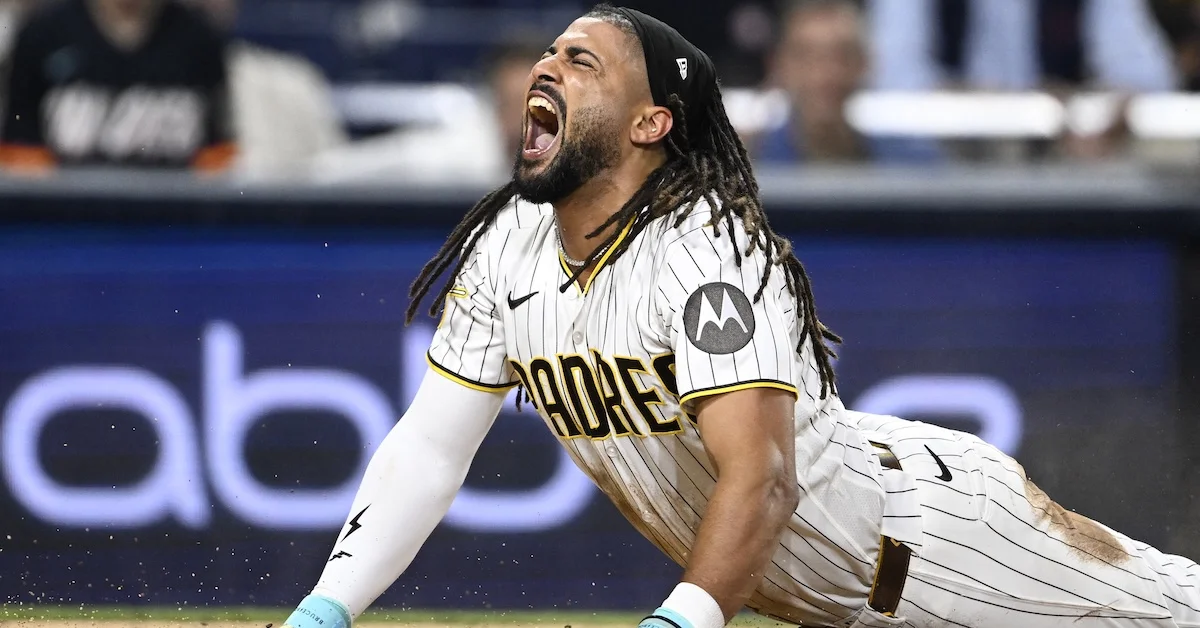
The scene? Petco Park, Game 1 of the National League Wild Card Series between the Chicago Cubs and San Diego Padres. The Padres hold a comfortable 7-0 lead in the bottom of the seventh inning. The actor? Fernando Tatis Jr., arguably the most exhilarating player in the game when he’s hitting all his marks. Looking to extend the lead — or maybe just have a little fun — Tatis takes off from first base on a 2-1 pitch and is rewarded with a curveball in the dirt, a basestealer’s delight. Tatis not only beats the throw to second, it pings off his sliding leg and into no man’s land, dribbling slowly into shallow left field as the Friar Faithful slowly ascertain what’s about to happen. Tatis is going turbo mode.
Moments like this bring fans to their feet and opponents to their knees. Tatis — who reached first on an infield single, and saw the opportunity to turn that hit’s 49.7 mph exit velocity into a run — seemed hellbent on scoring as soon as the ball caromed away from the Cubs’ infield. Is stealing a base with a touchdown-sized lead sort of reckless and unnecessary? Sure. But these are the playoffs, where it’s never a bad idea to add on, especially when presented with the opportunity to exploit a catcher like Carson Kelly, who struggled with the running game all year. We can assume Tatis merely read the scouting report and was putting that knowledge to good use. But once he took second, surely he’d chill there (with no outs!) and give the heart of the Padres’ order a chance to drive him in. Right? Wrong:

Tatis did not stop at third, and probably didn’t even consider doing so. Why would he? Because his third base coach explicitly told him to, long before Tatis even reached third base? That’s super boring. And Tatis, ever the entertainer, sensed that this blowout needed a little extra oomph before people started leaving to beat the traffic. Flying into third base, completely ignoring Bob Henley’s stop sign, and rounding for home are the sorts of moves that only the game’s great showmen have the ability to recognize, and even fewer have the aplomb to pull off. Lurking backlash for running up the score be damned (thankfully, the internet seemed to agree that this play was so awesome that he was spared any criticism), Tatis wants to remind everyone that he’s capable of things other ballplayers are not.
The Padres’ rambunctious right fielder, who has an 89th-percentile sprint speed, correctly identified that his speed would provide much more exhilaration in this situation than scoring from second on a Dustin Harris single would. Again, pretty unnecessary given the circumstance, but people don’t pay postseason ticket prices to see the mundane. They want to see superstars do superstar things, punctuated with the type of emotional outburst that makes postseason baseball so special. Does one man’s primal scream after diving across home plate register as much of a sound when 47,000 San Diegans are also screaming? Probably not, but it makes for one hell of a highlight:
FERNANDO TATIS JR. ARE YOU SERIOUS?! pic.twitter.com/hsHlrxILZk
— MLB (@MLB) September 30, 2026
None of this even accounts for the fact that Tatis started this baseball bash with a leadoff home run, giving him seven in 17 playoff games and boosting his lifetime postseason OPS to a nirvanic 1.178. All this from a man who finished April with a 75 wRC+ but who put up a 143 the rest of the way, giving him a strong chance to finish in the top five of MVP voting. His 2026 statistics will show yet another season with at least 25 homers and 25 steals — the fourth time he’s done that — with the lowest strikeout rate of his still-ascendant career to boot. But the numbers won’t tell the full narrative arc. His first home run of the regular season famously did not come until late May, and his team’s playoff odds sagged to a season-low 7.4% in July. The Padres were under .500 as late as July 25, and their deadline acquisitions of Casey Mize and Robbie Ray didn’t do much to help. But thanks to a bullpen unit that tied for second all-time in collective WAR, Jackson Merrill’s second-half revitalization, the surprise production of Harris, Ty France, and Samad Taylor, plus Tatis finding some sort of flow state (which may or may not have something to do with planetary alignment), the Padres are poised to advance into October.
The lesson here? Chase wild, thrill-seeking endeavors over playing it safe. This style of play might just be what San Diego needs in a hypothetical Division Series against the Milwaukee Brewers and their tight, fundamentally sound, 103-win operation. Run free, Fernando Tatis Jr., and deal with the consequences later. At the very least, you gave everyone something to marvel at and helped your team to a convincing win. Which is kind of the whole point of playing postseason baseball.