Mitch Garver Retires After 10 MLB Seasons and 110 Home Runs
Mitch Garver’s career was defined by the distance between what his bat could do at its best and what injuries allowed him to do over time. He retires after parts of 10 major league seasons, with a power surge in Minnesota and a World Series title in Texas among the clearest highlights. The shape of his career is familiar in baseball: a player can produce at an elite level in a short window, yet never get enough uninterrupted time to make that level his norm.
Ted Schwerzler of minnesotasportsfan.com reported Garver’s retirement. He played for the Twins, Rangers and Mariners, finishing with 702 games and 2,498 plate appearances. Those totals reflect both a long major league run and the interruptions that kept him from building a larger body of work.
A power peak in Minnesota
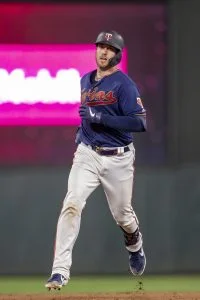 Minnesota drafted Garver in the ninth round in 2013, out of the University of New Mexico. His minor league offense stood out, while questions about his defense at catcher lingered. That combination made his path to a major league role less straightforward: a bat-first catcher has to hit enough to justify the demands of the position, particularly when his defense draws less praise. The Twins added him to their 40-man roster after the 2016 season, protecting him from the Rule 5 draft.
Garver debuted in 2017 and hit .196/.288/.348 without a home run in 52 plate appearances. He improved the next year, batting .268/.335/.414 with seven homers. Then came 2019: in just 93 games and 359 plate appearances, he hit 31 home runs and posted a .273/.365/.630 line. The season’s league-wide home run surge drew attention, but Garver’s production still rated 55% above average by wRC+. That measure puts his year in context: the broader power environment was part of the story, but it doesn’t account for how far his production exceeded the league. For a catcher, that kind of offense was a major asset, even as his defense drew less acclaim. This is more significant than it looks; strong hitting from behind the plate can change how a team allocates playing time across its lineup.
Injuries narrowed his opportunities. An intercostal strain limited him to 23 games in the pandemic-shortened 2020 season, when he also struggled at the plate. He missed time again in 2021, but hit 13 home runs in 243 plate appearances and finished with a .256/.358/.517 line and a 139 wRC+. That return showed the 2019 season wasn’t a one-off flash. And yet, the recurring absences made it difficult for Minnesota to count on that production across a full season.
From Texas champion to Seattle exit
The Twins had Ryan Jeffers emerging behind the plate, and they traded Garver to Texas before the 2022 season, receiving Isiah Kiner-Falefa and Ronny Henriquez. The deal reflected the roster problem in front of Minnesota: Jeffers was taking on more of the catching role, while Garver’s value depended heavily on his ability to hit. Kiner-Falefa moved to the Yankees the next day in a larger deal involving Josh Donaldson and Ben Rortvedt going to New York, with Gary Sánchez and Gio Urshela heading to Minnesota. For Garver, the move offered a chance to contribute on a new roster, though injuries soon limited that opportunity.
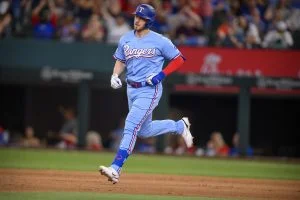
Garver’s first season with Texas was cut short by injuries. After 54 games, he underwent flexor tendon surgery in July. He rebounded in 2023 despite missing time with a knee sprain, hitting 19 homers and walking at a 12.8% rate in 344 plate appearances. His .270/.370/.500 line produced a 142 wRC+. That combination of power and patience made him a useful part of a lineup even without a full season of availability. He added three home runs in the postseason as the Rangers won the first championship in franchise history.
That title run set up a two-year, $24 million contract with Seattle, where Garver was expected to back up Cal Raleigh and serve as a part-time designated hitter. The role made sense on paper: it gave Seattle an experienced bat while leaving Raleigh as the primary catcher. But the fit didn’t produce. Garver hit .187/.290/.341 over two seasons, a sharp drop from his best work. The Mariners later brought him back on a minor league deal, and he made the 2026 Opening Day roster. Seattle released him in August after he hit .175/.302/.294 in 149 plate appearances. He then spent a brief spell with the Yankees on another minor league contract. A late return to the majors offered one more opportunity, but it couldn’t reverse the decline in his results.
Career numbers and what they show
Garver finishes with 497 hits, including 110 home runs, 301 runs scored and 324 RBIs. His career line was .229/.325/.432. FanGraphs credited him with eight wins above replacement; Baseball-Reference put him at 10.1 and estimated his career earnings at just under $35 million. The two WAR totals differ because the services use different methods to value a player’s contributions. Neither figure captures the whole story: his peak was unusually productive, while injuries and uneven later seasons shaped the total body of work.
His best years showed how much damage his bat could do when he was healthy. The Texas championship gave that run a fitting high point; after three difficult seasons, Garver’s playing career ends with that title among its clearest markers. He leaves a record of both a short, exceptional peak and a career repeatedly redirected by physical setbacks.
What Garver’s career says about roster value
Garver’s path also illustrates the narrow margin teams face with catchers whose main value comes from offense. If you’re working in this space, the practical question is how to preserve a productive bat while managing the physical demands of catching and the uncertainty of availability. His seasons in Minnesota and Texas showed that the payoff could be substantial. Seattle’s experience showed the risk when the production faded.
(and this is the part most people overlook) A championship can become the shorthand for a career, but it doesn’t erase the uneven seasons that came before or after it. Garver’s title with Texas is a major achievement; his career numbers also tell a more complicated story about what happens when a player’s strongest asset appears in bursts. Briefly brilliant. Hard to sustain.
Photos courtesy of Jordan Johnson, Jesse Johnson, Jerome Miron, Imagn Images