Chandler Simpson’s Speed Put Him Near Baseball’s Competitive Runs Record
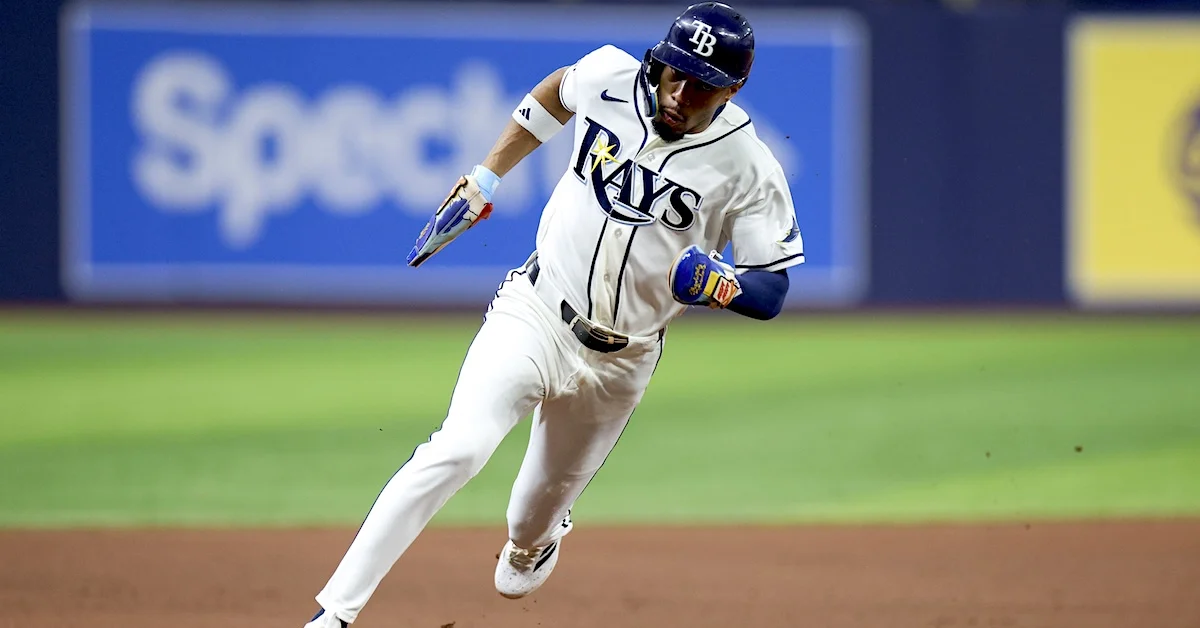
Chandler Simpson’s 2026 season offers a rare look at how much a lineup spot can shape a speed-driven player’s statistical ceiling. He finished with 359 competitive runs, fourth on the all-time single-season list, even though he collected fewer plate appearances than every other player in the top 10. My read: give him a full season near the top of the order, and the record could be within reach.
A stat built around full-speed baseball
Statcast tracks sprint speed on plays when a runner is likely pushing hard: a batter racing to first after a topped or weakly hit ball, or a runner advancing two or more bases. Scoring from second on an extra-base hit doesn’t count. A routine groundout, where the hitter eases down the line, isn’t a useful measure of maximum speed.
Competitive runs began as a way to select plays for sprint-speed calculations. But the total also captures something about how a player creates action. To pile up these runs, a hitter needs frequent chances to reach base or move multiple bases, along with contact that sends them charging down the line. Strikeouts limit those opportunities; walks can too, though less directly.
The category has a notable benchmark. Amed Rosario recorded 369 competitive runs in 2022, the highest single-season total cited in the data. Dee Strange-Gordon matched that figure in 2017, while Ben Revere came within one in 2015. Those totals came from players whose speed and contact skills repeatedly put the ball in play and forced defenses to react.
Simpson’s swing creates chances to run
Simpson is unusually suited to the stat. He has baseball’s fastest home-to-first time, and his swing is built to produce low line drives and hard groundballs. That approach gives up power, but it helps him keep the bat in the hitting zone and make contact. He posted the third-highest contact rate in baseball, according to the source, while rarely sending the ball into the air.
That profile has been visible throughout the playoffs. Simpson has laid down bunts, stolen bases, chased down fly balls and made infielders rush throws. Those plays reflect the same underlying trait: he turns routine contact and baserunning opportunities into tests of defenders’ range and execution.
His regular-season numbers fit the pattern. Simpson led the American League in steals and came close to winning a batting title. He also led the majors with 359 competitive runs. That’s only 10 behind the record, despite a much smaller workload than the players ahead of him.
Batting order is the missing piece
Competitive runs are a counting stat, so opportunities matter. Rosario had 670 plate appearances when he set his mark; Strange-Gordon had 695, and Revere had 634. Simpson finished with 612. The difference is especially striking because the other players on the leaderboard spent most of their time batting first or second, while Simpson made the largest share of his plate appearances in the fifth spot. He also batted sixth almost as often as he led off.
That positioning costs a hitter chances to come to the plate. A past calculation cited by the source found that an average ninth-place hitter would need 26 more games than a leadoff hitter to qualify for the batting title, assuming neither was pinch-hit for. Teams have increasingly placed their best hitters second, but Simpson hasn’t held a top-of-the-order role consistently.
His performance against left-handed pitching helps explain why. The Rays sometimes sit him against lefties, against whom he has a 76 wRC+ across his two major-league seasons. His overall wRC+ in 2026 was 93. Rosario, by comparison, posted a 104 wRC+ in his record-setting 2022 campaign. A stronger offensive season could earn Simpson more starts and a regular leadoff assignment, especially on a Rays team described in the source as having one of the league’s better offenses.
Put the totals on a rate basis, and Simpson already stands out: he averaged 0.59 competitive runs per plate appearance. That means roughly six in every 10 trips to the plate came with a play that qualified as a competitive run. His total reflects both extraordinary speed and the way his swing keeps producing the kinds of contact that let him use it.
A record pace with room to grow
Simpson was 25 and in his second major-league season at the time described. There’s no guarantee his hitting will improve, but he has time to develop. Baseball America’s JJ Cooper also noted that Simpson was pursuing an unusual milestone: becoming the first player to win a batting title in college, the minors and the majors.
He doesn’t need a major offensive leap to change his place in the lineup. Because his speed adds value to his overall profile, even a modest improvement could strengthen the case for everyday leadoff work. If he gets that opportunity for a full season, his 359 competitive runs suggest the 369 mark is vulnerable—and that a counting stat designed to measure sprint speed may become one of the clearest ways to see Simpson’s impact.
| Year | Player | Competitive Runs | PA | AVG Batting Position |
|---|---|---|---|---|
| 2022 | Amed Rosario | 369 | 670 | 2.5 |
| 2017 | Dee Strange-Gordon | 369 | 695 | 1.3 |
| 2015 | Ben Revere | 368 | 634 | 2.3 |
| 2026 | Chandler Simpson | 359 | 612 | 4.2 |
| 2017 | Elvis Andrus | 348 | 689 | 2.8 |
| 2016 | Mookie Betts | 344 | 730 | 1.8 |
| 2017 | Jose Altuve | 343 | 662 | 2.7 |
| 2016 | Jean Segura | 342 | 694 | 1.1 |
| 2016 | Adam Eaton | 342 | 706 | 1.3 |
| 2017 | DJ LeMahieu | 341 | 682 | 2.0 |