Jordan Walker’s 2026 Breakout Makes Him a Premium Fantasy Draft Target
Jordan Walker’s 2026 season changed the fantasy conversation around him. Drafted at an average position of 359.2 in NFBC leagues, the St. Louis Cardinals outfielder finished 10th in dollar value, according to FanGraphs’ Player Rater. That return came from a rare combination: loud contact, improved swing speed and 22 stolen bases. The next question is whether his strikeout rate can stay in the 20s as his draft price rises.
A risky pick with a clear source of upside
Walker entered last spring carrying plenty of uncertainty. Across 162 games in 2024 and 2025, he hit .211/.270/.324 and struck out 30.7% of the time. The Cardinals sent him to Triple-A Memphis in both seasons to clear his head and work on his swing, but the minor league results offered little reassurance. His production didn’t improve much after returning to St. Louis.
There was still a reason to believe in his bat. Walker’s contact remained exceptionally hard in 2025: his hard-hit rate ranked in the 87th percentile, his barrel rate in the 66th, and his average exit velocity in the 91st. The problem was making contact often enough. His strikeout rate rose to a career-worst 31.8%, while a 47.5% ground-ball rate and just 11.3% pulled fly-ball rate limited the damage his power could do.
That profile made Walker a late-round wager rather than a safe pick. His physical tools were apparent, but the swing decisions and contact problems left open the possibility that the power would never translate consistently. The offseason work gave fantasy managers a reason to reconsider that risk.
Mechanical work began to show up
Walker spent the previous offseason working at Driveline Baseball, focusing on keeping his right hip back to improve his balance and preserve his natural power. Training at a data-driven facility doesn’t guarantee a turnaround, but his work gave manager Óliver Mármol a reason to stay patient through a poor start to spring training.
Walker went 6-for-28 (.214) in his first 10 Grapefruit League games, with no extra-base hits and two walks against 11 strikeouts. The Cardinals then held him out for three days so he could work in the batting cages. Mármol backed him, pointing to the attention Walker was giving the process.
“We’re excited about the work he’s doing, the attention to detail, and that hasn’t changed,” Mármol told SI.com. “You stay focused on those things because, eventually, they’re what will get him where he needs to go.”
Walker reached base four times and homered in his final two spring games. He carried that form into the regular season, posting a 1.116 OPS with eight home runs across his first 16 games. By the end of May, he was batting .290/.357/.551 with 15 homers, 43 RBIs, seven walks and a 24.4% strikeout rate.
He and Mármol have both credited better communication with the coaching staff. Walker described using movement data to identify when his swing felt comfortable or out of sync, then discussing those findings with coaches. “When I see the data I can talk about it, and then we can try to speak their language,” he said during the final week of the regular season in an MLB.com interview. The key change, by Walker’s account, was making those conversations specific enough to connect what he felt at the plate with what the staff could measure.
Power held up, and speed added another dimension
Walker’s most visible moment came at the Home Run Derby in mid-July. He rallied to beat Kyle Schwarber in the final at Schwarber’s home park, then endured a quieter second half that prompted talk of a Derby hangover. His August line—.305/.348/.505 with five homers—offers a straightforward rebuttal. Research on the supposed Home Run Derby curse has also found little basis for treating it as a real effect; a SABR review examines the evidence.
September was a tougher story. Walker hit .172/.232/.287 with two home runs and a 36.8% strikeout rate. The Cardinals later revealed he had been dealing with hip discomfort late in the season. A first full major league campaign can also wear on a young hitter, especially once opposing pitchers start tailoring their plans to him.
The broader contact data still point to a meaningful change. Walker’s ground-ball rate fell to 42.8%, below the league average for the first time, while his pulled fly-ball rate reached 15.9%. His hard-hit rate was 49.9%, his barrel rate 13.2%, and his average exit velocity 92.6 mph—each at or above the 90th percentile.
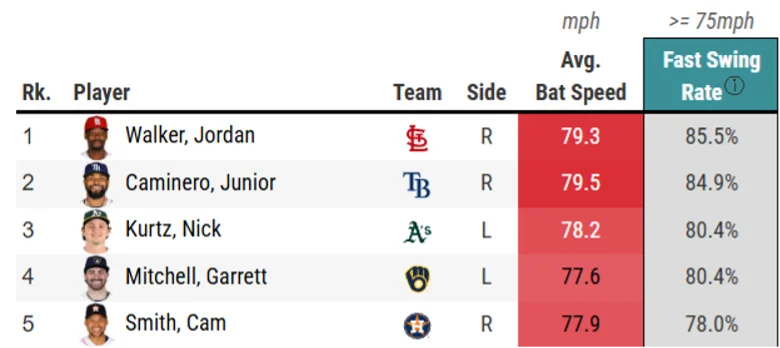
His swing speed added another clue. Walker averaged 79.3 mph, the second-highest mark in baseball behind Junior Caminero. His fast-swing rate—the share of swings reaching at least 75 mph—led the majors. After posting a 76.2% fast-swing rate across 2024 and 2025, he jumped to 85.5% in 2026. That increase suggests he was able to swing with greater comfort and conviction.
The surprise extended beyond the batter’s box. Walker stole 22 bases and was caught five times. At 6 feet 6 inches and 250 pounds, he doesn’t fit the usual image of a base stealer, but his sprint speed ranked in the 91st percentile. Once he began reaching base more often, the opportunity to run became easier to use. He finished one home run short of joining the small group of players with at least 30 homers and 20 steals.
The draft case now depends on the strikeouts
There are limits to the breakout. Busch Stadium III has been one of the harder parks for right-handed hitters to homer in over the past three seasons; only Pittsburgh’s PNC Park has been less favorable. Walker hit 19 home runs on the road and 10 at home in 2026, a split that makes the park effect hard to ignore.
The Cardinals’ supporting lineup also remains a concern. Their offense was better than expected, but still ranked in the bottom third of the majors with a 93 wRC+. The club isn’t likely to be a major player in free agency this winter, so Walker may continue to have modest lineup support. That didn’t prevent him from producing strong counting stats this season, though, and his own power and speed provide much of the appeal.
Walker’s rebound is a reminder that a highly regarded young prospect can remain worth a second look after a difficult stretch, especially when hard contact persists. He’ll turn 25 in May, so there’s still room for the adjustments to hold. His future fantasy value will hinge on whether he keeps his strikeout rate in the 20s rather than slipping back into the 30s.
That makes him a more expensive pick next spring, but the price increase doesn’t erase the upside. My read is that Walker can justify a premium selection if the improved contact and swing decisions carry forward. The clearest signal to watch is simple: whether he can keep attacking the ball without giving away so many plate appearances to strikeouts.