Top MLB Trade Candidates to Watch as the Offseason Market Opens
|
5 min read
The offseason trade market has room to move
Milwaukee’s celebration marks the start of the offseason, but trade talks can resume now. Free agency won’t officially open for five days, while clubs sort through option decisions and get an exclusive window to negotiate with their own free agents. Trades face no such pause: teams can talk again for the first time since August 3. The market could be unusually active. Only a few clubs are in full rebuild mode, which may push teams toward swaps that address needs on both sides. A thin free agent class, especially among position players, gives clubs looking for offense fewer ways to find it. And with a lockout expected on December 1, front offices have reason to get deals done during the next five weeks. That pressure could speed up the market, though it’s hard to know how much business teams can realistically finish before the deadline. This list weighs both a player’s trade value and the odds he’ll be available. Those judgments are subjective. Several names farther down could rise into the top 5 or 10 if reporting offers stronger evidence that their teams are willing to move them. MLBTR contributor Matt Swartz supplied the [arbitration projections](https://www.mlbtraderumors.com/2026/10/projected-arbitration-salaries-for-2027.html); projected years of team control assume the coming collective bargaining agreement leaves service-time rules unchanged. *No-trade rights are marked with an asterisk.*1. Reid Detmers, Angels, LHP
**Arbitration eligible through 2028; projected 2027 salary: $7.5 million** The Angels have a hard choice: keep a pitcher coming off his best season, or trade him while two years of arbitration control still carry real value. They discussed [Detmers](https://www.baseball-reference.com/players/d/detmere01.shtml?utm_medium=linker&utm_source=www.mlbtraderumors.com&utm_campaign=2026-10-27_br) and [José Soriano](https://www.baseball-reference.com/players/s/soriajo02.shtml?utm_medium=linker&utm_source=www.mlbtraderumors.com&utm_campaign=2026-10-27_br) at the deadline, a sign the club was at least considering a longer-term reset after years of avoiding one. Soriano was the only one dealt then. Detmers should draw another round of calls. The 27-year-old, a former top-10 draft pick, started all 32 games and posted a 3.36 ERA over 185 innings. He struck out 28.5% of hitters and walked 6.5%, while taming the home-run trouble that had marked earlier seasons. His post-All-Star break run was especially strong: a 1.89 ERA across 13 starts. That’s a persuasive profile for a No. 2 or strong No. 3 starter. Detmers works around 94 mph, has two breaking pitches that miss bats, and showed the best command of his career. He handled hitters from both sides and stayed effective through the lineup. His salary is projected at $7.5 million next year, with roughly $20 million due across his remaining arbitration seasons. The Angels’ timeline is the complication. It’s unclear how serious they are about rebuilding, but competing within Detmers’ control window looks like a steep climb. After trading Soriano, Los Angeles received top shortstop prospect [Arjun Nimmala](https://www.baseball-reference.com/register/player.fcgi?id=nimmal000arj&utm_medium=linker&utm_source=www.mlbtraderumors.com&utm_campaign=2026-10-27_br) from Toronto. Detmers could command a comparable headline prospect, likely with a stronger supporting package. Plenty of contenders could fit him into their rotation and budget.2. Drew Rasmussen, Rays, RHP
**$20 million club option for 2027** Rasmussen’s price has climbed to $20 million, but his performance makes that figure look like a bargain. The Rays are expected to exercise the option. Whether they keep him is another matter: the club has never carried a player at that salary and is likely to run a payroll in the low nine figures, even after a pennant run. One year of control over an elite starter could bring back affordable pitching or other useful pieces. Rasmussen delivered 172 innings with a 2.67 ERA this season, striking out 26% of opponents and walking just 5%. He finished ninth in AL Cy Young voting in 2025 and could land in the top five this time. His regular-season results carried into the postseason. Over the past two years, only 11 pitchers have thrown at least 250 innings with an ERA below 3.00; that group includes Cy Young winners and established aces. The injury history explains why the Rays built in an escalator. Rasmussen was a first-round talent who fell to the sixth round after two Tommy John surgeries at Oregon State. An internal brace procedure on his ulnar collateral ligament limited him to 73⅓ innings across 2023 and 2024. The Rays’ two-year extension, signed before 2025, bought out his final arbitration seasons and included a 2027 club option that started at $8 million. Staying healthy pushed it to $20 million. He did.3. Zach Neto, Angels, SS
**Arbitration eligible through 2029; projected 2027 salary: $9.8 million** Neto is a less likely trade than Detmers, with three years of control and fewer health concerns than a pitcher. But if Los Angeles commits to a full rebuild, its shortstop would be among the biggest names available. The 2022 first-round pick has become a franchise regular. Baseball Reference has credited him with roughly five wins above replacement in each of the past three seasons; FanGraphs places him in the three-to-four range. His defensive evaluations vary, but his power and speed stand out for a middle infielder. Neto has gone 20-20 in three straight years. In 2026, he hit 27 home runs, stole 24 bases in 36 attempts, and produced a .239/.330/.436 line over 704 plate appearances.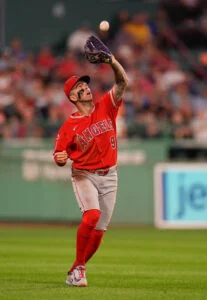 There are limits to the package. Neto strikes out often, gets caught too much on the bases, and can make defensive mistakes. He’s a tier below stars such as [Bobby Witt Jr.](https://www.baseball-reference.com/players/w/wittbo02.shtml?utm_medium=linker&utm_source=www.mlbtraderumors.com&utm_campaign=2026-10-27_br) and [Elly De La Cruz](https://www.baseball-reference.com/players/d/delacel01.shtml?utm_medium=linker&utm_source=www.mlbtraderumors.com&utm_campaign=2026-10-27_br). Still, three years of control over an above-average shortstop has substantial value, particularly when the free-agent market offers almost no help at the position.
At the deadline, the Angels reportedly asked about Boston prospect [Franklin Arias](https://www.baseball-reference.com/register/player.fcgi?id=arias-008fra) while discussing Neto. That would be an ambitious return. Los Angeles could reasonably seek multiple Top 100 prospects, including a centerpiece in the top 25 to 50. Nimmala, acquired for Soriano, hit well in Double-A and could eventually take over at shortstop, though the Angels would need a veteran bridge during another likely rebuilding season.
4. George Kirby and 5. Emerson Hancock, Mariners, RHP
**Kirby: arbitration eligible through 2028; projected 2027 salary: $9.8 million** **Hancock: pre-arbitration; controllable through 2030** Seattle has spent years hearing speculation about trading a starting pitcher. It finally moved [Luis Castillo](https://www.baseball-reference.com/search/search.fcgi?pid=castilu02,castilu01,castil007lui,castilu03,castil025lui,castil018lui,castil026lui&search=Luis+Castillo&utm_medium=linker&utm_source=www.mlbtraderumors.com&utm_campaign=2026-10-27_br) to the White Sox this summer, but the homegrown rotation remains intact. That may change now. The Mariners are unlikely to move touted rookie [Kade Anderson](https://www.baseball-reference.com/players/a/anderka01.shtml?utm_medium=linker&utm_source=www.mlbtraderumors.com&utm_campaign=2026-10-27_br). The rest of the staff could come up in talks: [Logan Gilbert](https://www.baseball-reference.com/players/g/gilbelo01.shtml?utm_medium=linker&utm_source=www.mlbtraderumors.com&utm_campaign=2026-10-27_br) is entering his final arbitration year; [Kirby](https://www.baseball-reference.com/players/k/kirbyge01.shtml?utm_medium=linker&utm_source=www.mlbtraderumors.com&utm_campaign=2026-10-27_br) has two years of control; [Bryce Miller](https://www.baseball-reference.com/search/search.fcgi?pid=millebr04,miller014bry,miller013bry&search=Bryce+Miller&utm_medium=linker&utm_source=www.mlbtraderumors.com&utm_campaign=2026-10-27_br) and [Bryan Woo](https://www.baseball-reference.com/players/w/woobr01.shtml?utm_medium=linker&utm_source=www.mlbtraderumors.com&utm_campaign=2026-10-27_br) have three; and Hancock has four. Anderson might still get calls, but Seattle would likely shut those conversations down quickly. Kirby and Hancock were the most visible names in deadline chatter. Seattle appeared to test the market on Hancock as a potential sell-high move, while taking a more exploratory approach with Kirby. Hancock, once the sixth overall draft pick, made 25 starts with a 3.57 ERA. His 22.3% strikeout rate was a career best, up six points, after he changed his pitch mix: more four-seam fastballs, fewer sinkers, and a cutter that worked well against left-handed hitters. They had hit his changeup hard in 2025. The new version looks like a solid third starter, though a left abductor strain ended his season a month early. He should have a normal offseason. Kirby’s outlook is less settled. He has shown the ceiling of an All-Star, but his 4.33 ERA and career-low 20% strikeout rate over 30 starts point to a down year. His command has slipped from exceptional to merely very good, and he struggled away from Seattle’s pitcher-friendly T-Mobile Park. Still, his average fastball velocity rose from about 96 mph to nearly 97. Against right-handed hitters, the strikeout and walk numbers remain strong. A contender could see a small adjustment restoring his No. 2 starter form. Seattle’s reason to consider a rotation trade is straightforward: it needs offense. The Mariners ranked 28th in scoring and could lose their best hitter, [Randy Arozarena](https://www.baseball-reference.com/players/a/arozara01.shtml?utm_medium=linker&utm_source=www.mlbtraderumors.com&utm_campaign=2026-10-27_br), to free agency. A major addition in the corner outfield looks necessary, and shortstop could also be an upgrade target. Read moreHouston’s infield logjam
Isaac Paredes and Christian Walker give the Astros two trade options, but they carry very different price tags. Paredes is productive and fits Houston’s home park; Walker could cost the club money to move. Either deal would clear space in an infield that’s crowded again. Houston’s interest in finding a left-handed bat put Paredes in trade rumors last offseason. Then he went down with a potentially season-ending injury before the 2025 deadline, and the Astros brought Carlos Correa back to play third. The plan left little room for Paredes: Jeremy Peña had shortstop, Jose Altuve was back at second after a brief stint in left, and Walker was entrenched at first on a three-year, $60 million deal. With Yordan Alvarez taking most of the designated hitter work, there wasn’t an obvious place to hide another bat. Houston kept Paredes, then under team control for two more years. That choice paid off when Peña and Correa both got hurt early. The lesson is that an apparent surplus can disappear quickly. Still, all five infielders are back this winter, and Alvarez remains the DH. Injuries may resolve the squeeze again, but the Astros have reason to listen: Walker has one year left, while both players are headed toward free agency after the season.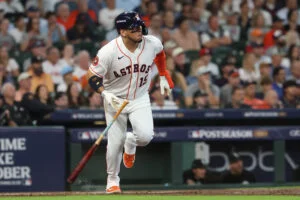 Paredes hit .262/.360/.447 with 25 home runs in 2026. His third-base defense was below average, but he handled first adequately in 15 games and made occasional appearances at second, where he’s an emergency option rather than a long-term answer. His projected $15 million arbitration salary exceeds his $13.35 million club option, so whoever holds the contract is likely to exercise the option. Paredes has real trade value, and his pull-heavy, fly-ball swing suits Daikin Park’s short left-field porch. Moving him would mean giving up a useful fit.
Walker’s case is less appealing on the field and more complicated financially. He started strongly, then faded, finishing with 29 homers and solid defense at first. At 35, his .226/.299/.427 line makes his $20 million 2027 salary hard to swallow. A buyer might take on around 40% of what remains, letting Houston save some money and clear a roster spot. Walker also criticized Astros fans after the team was booed during a Wild Card loss to the White Sox, a dispute that could make a fresh start attractive to both sides. [He spoke publicly about the episode](https://www.nytimes.com/athletic/7646661/2026/09/30/houston-astros-fan-boo-wild-card-bennett-sousa/).
St. Louis must decide when to cash in
Alec Burleson has become a dependable hitter, and the Cardinals could get a strong return if they trade him. But the timing depends on whether St. Louis expects to contend in 2027. The club was in the race for much of the first half before its pitching collapsed, forcing a deadline sale. Burleson helped the offense exceed expectations, hitting a career-best 26 home runs and batting .279/.343/.473 while earning $3.3 million. The 27-year-old, who turns 28 in late November, has been an above-average hitter for three straight seasons and a plus hitter in each of the last two. Since 2024, he has hit .279/.324/.451; since 2025, .284/.343/.466. His projected salary rises to $8.3 million, still affordable for St. Louis. The bigger question is that he has only two years of club control left. If president of baseball operations Chaim Bloom isn’t building toward a serious 2027 run, listening now could make sense while Burleson’s value is high. There’s no deadline forcing a deal. The Cardinals could wait until the summer or next winter and still find a market; if they’re contending in 2028, Burleson could remain part of the plan. He’s a prime-aged first baseman who has struck out in just 16% of his plate appearances over the past two seasons. That profile should interest buyers, though the free-agent market includes options such as Jake Bauers, Ty France and Alec Bohm. The Cardinals should be available to move him if a club offers the pitching they need.Cleveland’s late-season Kwan surge changes the calculus
Steven Kwan’s first half looked like a warning sign. He carried a .212/.318/.257 line into July after an ugly finish to 2025, and non-tender speculation followed. Then the season turned. From July on, Kwan led the majors in batting average and on-base percentage, hitting .352/.445/.441. He finished at .282/.382/.349, with a career-high 13.3% walk rate and a strikeout rate below 10%. The power nearly vanished—three home runs and a .067 isolated power—but he still ranked among the top 10 qualified hitters in OBP. His defense adds value that a batting line can’t capture. A four-time Gold Glove left fielder, Kwan also started nearly half of Cleveland’s games in center and rated well there across 637 innings: six Defensive Runs Saved and six Outs Above Average. His usual work in left remained strong. Cleveland president of baseball operations Chris Antonetti [played down the possibility of a trade](https://www.mlbtraderumors.com/2026/10/guardians-notes-kwan-velazquez-rotation.html), saying, “As we sit here today, we’re expecting Steven Kwan to be a big part of a contending team next year.” That’s plausible: the Guardians need outfielders and have limited 2027 commitments, so a projected arbitration salary above $11 million is manageable. They may not extend him, but could issue a qualifying offer after 2027. The complication is Cleveland’s history of trading star players this close to free agency, with José Ramírez the notable exception. The Padres, Phillies, Cubs, Giants, Yankees, Astros, Blue Jays and Reds could all call. Kwan’s rebound makes him a more valuable player—and a more difficult one for Cleveland to replace.Boston may have a change-of-scene candidate
Jarren Duran’s near-20-20 season looks much worse when you check the rate stats. In 608 plate appearances, he hit .207/.266/.361, career lows across a full season. Among 135 qualified hitters, only Ezequiel Tovar reached base less often. Duran’s walks, strikeouts and hard contact all moved in the wrong direction. Boston reportedly made him available at the deadline. That came shortly after Duran appeared to criticize third-base coach Chad Epperson for holding him at third on a would-be sacrifice fly. The Red Sox then went quiet at the plate in September and managed two runs across two lopsided Wild Card games against the Yankees; Duran never found a rhythm. Boston could pursue a bigger bat to share left field and DH with Roman Anthony. Duran’s projected arbitration salary has climbed to $11.1 million, leaving a non-tender possible, though another club could take a chance on a reset. From 2023 through 2025, he hit .276/.339/.471 in nearly 1,800 plate appearances. He runs well and defends left field; he could also manage center for a team without a Gold Glove option like Ceddanne Rafaela. With two years of control remaining, he could fit the Giants, Cardinals, Rangers, Angels or Phillies.Texas has expensive decisions to make
Jacob deGrom has the power to block any trade, and he used it once already. His five-year, $185 million Rangers contract includes a full no-trade clause; he invoked it to stop deadline discussions with Atlanta about a deal that might have sent Spencer Strider to Texas. The reported veto could mean deGrom simply wants to stay. It could also mean he preferred to revisit the idea in the offseason; the available information doesn’t settle that. The Rangers have missed the playoffs three years running despite a division that offered plenty of openings. Their roster is older and expensive, while ownership has limited payroll flexibility in both the offseason and at the deadline. Texas may not be ready for a full teardown, but shedding some large contracts would help.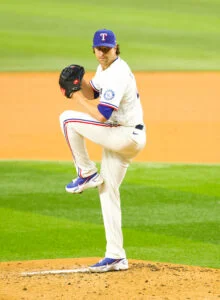 DeGrom is due $37 million in 2027, the final guaranteed year of his deal. His contract includes a $20 million club option for 2028 after he underwent Tommy John surgery; that option rises to $30 million if he finishes in the top five of Cy Young voting next year. If he’s willing to waive his clause, contenders with money could be interested. His 4.20 ERA was ordinary, but he struck out 30% of opponents and still threw in the upper 90s. At 39, he’d remain an impact-starter bet. Atlanta could return to the conversation, with the Dodgers, Padres and Red Sox also plausible fits.
Corey Seager would also have to approve a move. His 10-and-5 rights give him full no-trade protection, and his contract calls for $31 million annually from 2027 through 2031—a total of $155 million for his age 33–37 seasons. That’s a steep commitment for a player who spent time on the injured list three times in 2026, twice with lower-back problems, and hit .227/.312/.424 in 436 plate appearances.
Still, his season was split in two. After returning from his final IL stint on July 31, Seager hit .269/.332/.472 with 10 homers in 51 games. A thin free-agent shortstop class could make him attractive to a team seeking help at short or third. He can still play shortstop, though a move to the hot corner is possible. If Texas covered enough salary to bring his annual cost down to roughly $22–25 million, Atlanta or the Yankees might explore whether he’d agree.