Arch Manning’s Texas Future Faces Questions as Draft Stock Slips
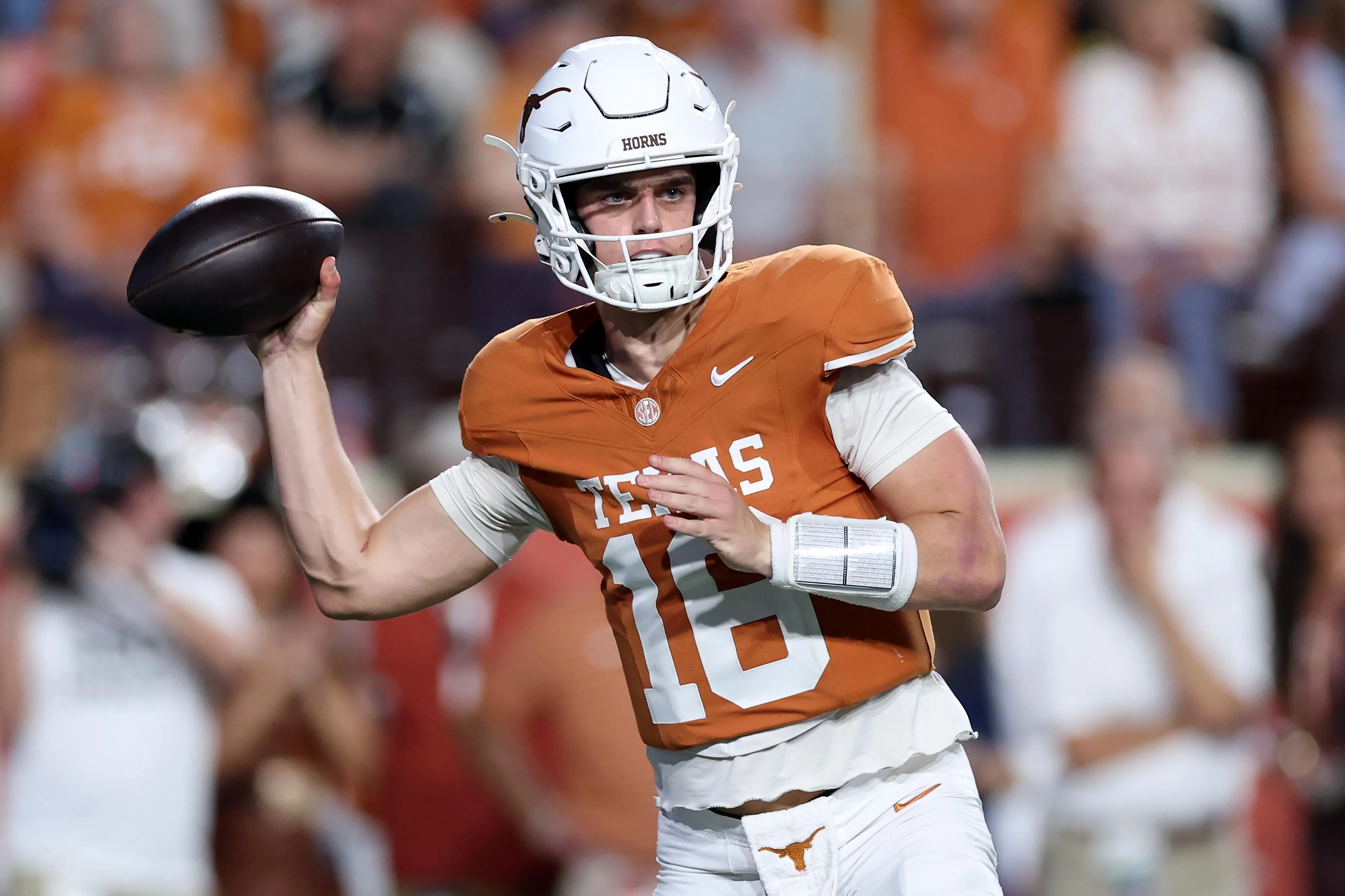
Arch Manning’s season has become a test of two competing stories: the talent that can make him look like a future No. 1 NFL draft pick, and the decisions that have helped pull Texas into dangerous moments. The Longhorns escaped Ole Miss in overtime, but that win didn’t settle the questions. It put them in sharper focus.
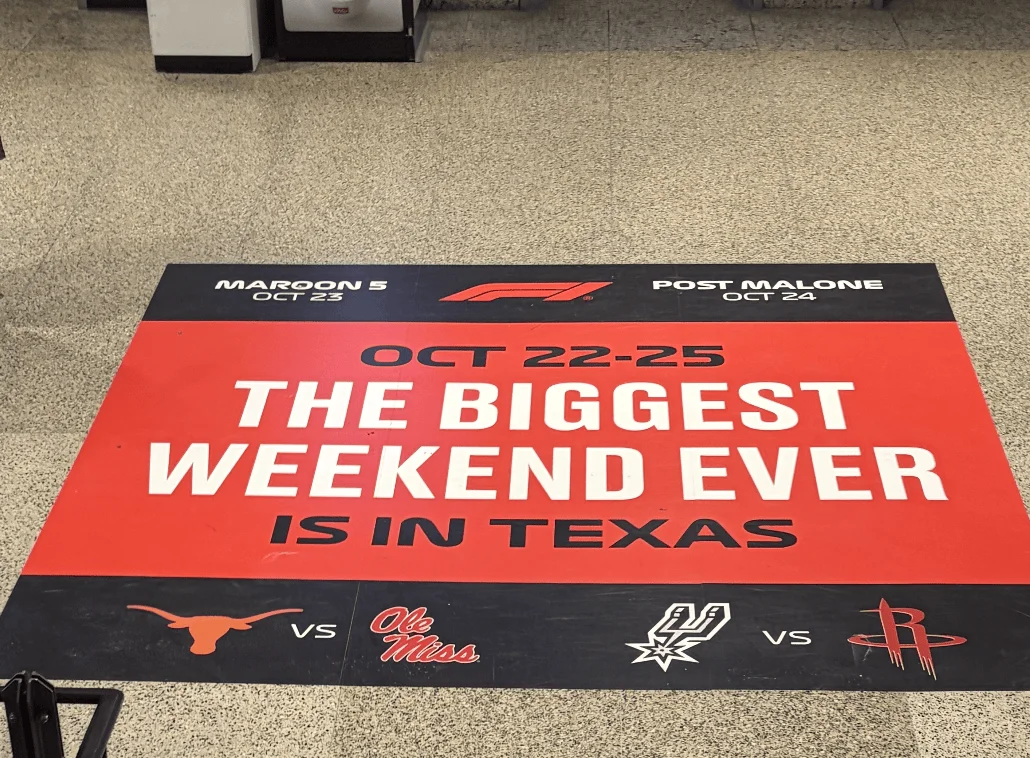
Texas arrived at the game under pressure after losses to Oklahoma and Florida. In Austin, the Longhorns were even billed as an undercard to the Formula 1 United States Grand Prix and a San Antonio Spurs–Houston Rockets matchup, an unusual place for a Texas game to land. The attention on Manning was anything but secondary.
His performance against Ole Miss captured the uncertainty surrounding his season. Some of the trouble came from the conditions around him; some came from choices he made. For NFL evaluators, separating those strands is the work ahead.
The gap between the flashes and the mistakes
Ole Miss’ comeback began with a fumble by Manning, but the play is difficult to treat as a simple quarterback error. Texas’ left tackle was beaten, and Manning was hit from behind as he prepared to throw a checkdown. A quarterback can be asked to sense pressure sooner and speed up his process, but the protection breakdown matters too.
The interception that followed was a different matter. With the score tied 24-24 in the fourth quarter, Manning threw deep while facing pressure, sending the ball into tight coverage with a defender positioned over the target. Ole Miss came away with possession and a chance to take the lead. That decision belongs squarely in the quarterback’s column.
It echoed Manning’s late interception against Oklahoma. With about 20 seconds left, a second-down throw gave the Sooners an opening to win. Texas survived Ole Miss; it wasn’t as fortunate against Oklahoma. The distinction between a risky throw and a defining mistake often comes down to the scoreboard, but both plays raise the same questions about timing, awareness and decision-making.
Then there are the throws that explain why Manning has attracted so much attention. Against Ole Miss, he held his ground under pressure, worked his eyes across the defense and delivered a deep ball to Ryan Wingo for a 50-yard touchdown. Against Oklahoma, he moved left in the pocket while keeping his eyes downfield, then completed a difficult throw to Cam Coleman for a score.
Those sequences show the arm talent, pocket movement and field vision that could make Manning an early draft selection. The problem is that the highlight throws sit beside decisions that can hand an opponent a game. An interception against Tennessee, for example, came when Texas had a high-low concept available and Manning forced a deep ball into double coverage.
That inconsistency has affected the way draft watchers view him. Manning spent the summer projected as the expected No. 1 pick, but his standing has since slipped, with Drew Mestemaker rising past him as the top quarterback in projections tracked by NFL Mock Draft Database. Manning remains in the first round in those projections, though further uneven play could change that.
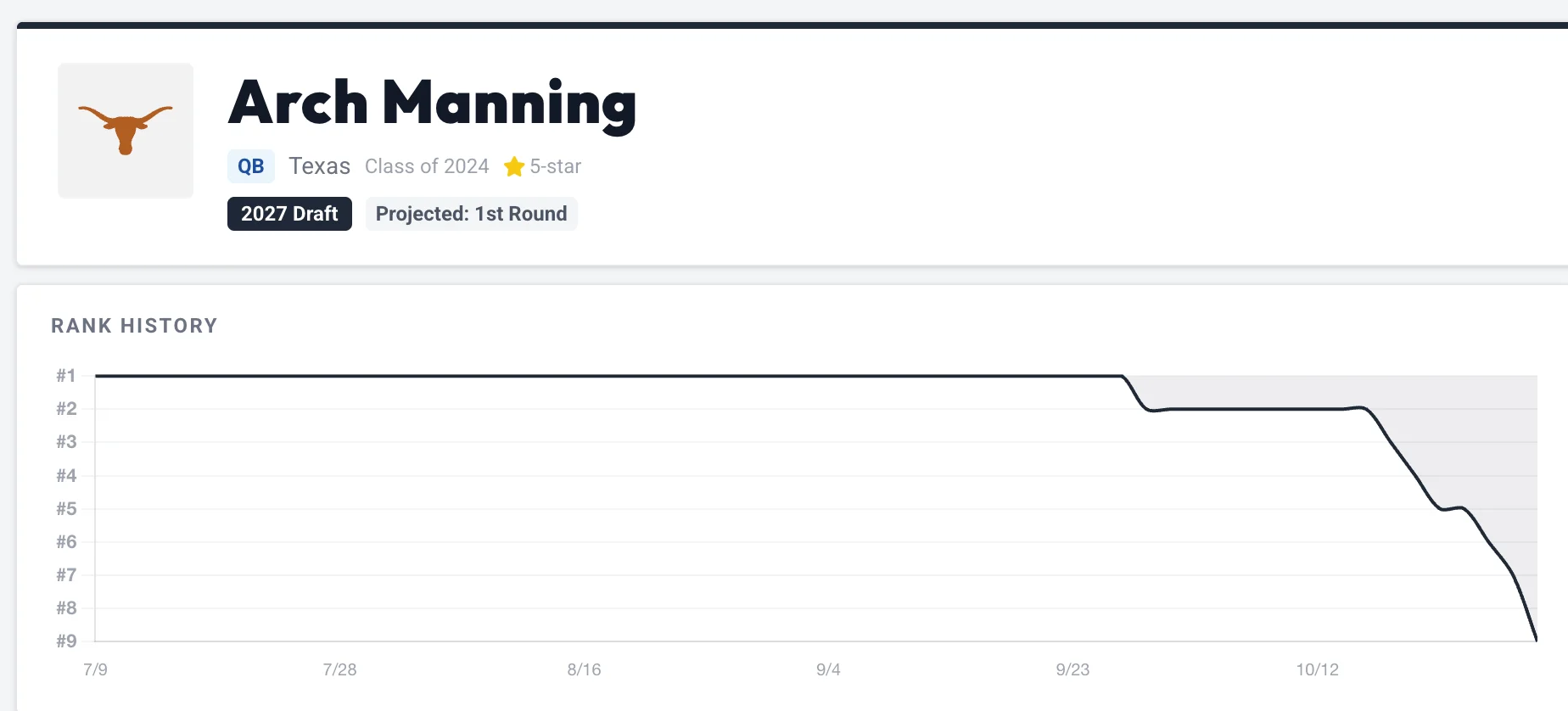
Mock drafts are fluid, and Manning’s stock dipped last season before he finished strongly. A strong close to 2026 could again shift the conversation. But the current concern isn’t just where he might be drafted. It’s whether he can show the week-to-week judgment and consistency teams expect from a quarterback with his reputation.
A possible college season beyond Austin
That uncertainty has widened the discussion beyond the NFL. Manning could return for his final year of college eligibility, and some commentators have argued that a different offensive system might give him a better setting to develop. Ole Miss, where his grandfather Archie and uncle Eli played, and LSU, coached by Lane Kiffin, have been floated as possible destinations.
Jordan Palmer made the case on ESPN’s “Get Up” that Texas’ offense may be limiting what Manning is asked to do. Palmer cited a statistic from Hembo: 48% of Manning’s throws are either at or behind the line of scrimmage or travel 20-plus yards downfield. Palmer argued that this leaves Manning with either a short, easy option or a low-percentage deep attempt, while offering too few chances to work through the short and intermediate parts of the field.
“Well Arch has got to be allowed to play quarterback, and he’s really not right now. Hembo had a great stat for me. 48% of his throws are either at or behind the line of scrimmage or 20+ yards downfield. That’s by far one of the highest in the entire country. So it’s either a quick, easy layup or a bomb downfield that’s low percentage that puts him in trouble. We’ve seen some interceptions there.
“He’s not allowed to really — maybe he’s not allowed or he can’t, either way — he doesn’t change things pre-snap. This offense doesn’t allow him to slide protections, read Mike. You don’t see him doing some of that. He also doesn’t get full-field progressions where they’re attacking the short to intermediate area of the field. Where he’s working one, to two, to three, to four reads.”
That critique puts pressure on Steve Sarkisian, Texas’ head coach and play caller. Sarkisian is widely regarded as a gifted offensive designer, but the questions now extend to how his system is helping Manning grow. Manning waited behind Quinn Ewers, another highly touted recruit who was projected as an NFL prospect before falling to the seventh round of the 2025 draft as the 13th quarterback selected. Ewers’ path doesn’t prove that Texas failed to develop him, but it gives critics a reason to scrutinize the program’s quarterback outcomes.
Paul Finebaum has been particularly sharp in his criticism of Sarkisian. After Texas’ struggles, Finebaum said, “I’m beginning to wonder if Arch Manning should even start,” and blamed the coach for what he saw as a mishandling of the quarterback. He also withdrew his earlier praise of Sarkisian as an elite play caller, arguing that the offense and the team’s sideline management had become a problem. Finebaum softened his stance after the win over Ole Miss, but his comments helped bring the development debate into wider view.
“What a disaster. The absolute arrogance of [Steve] Sarkisian to crack back at people like me and others with the idiotic take of the year that if his [Manning’s] name was Joe Smith, you would be praising him,” said Finebaum on The Matt Barrie Show. “I’m beginning to wonder if Arch Manning should even start. I know he will, and he’s capable of leading them to a win, but I blame Sarkisian for every aspect of this.
“And until last week I called (Sarkisian) an elite play caller,” Finebaum continued. “He’s not. I have no earthly idea what Steve Sarkisian is doing. I think we all agree he shouldn’t be calling the plays. There’s too many other things going on in that sideline that are distracting, and he has made an absolute mess out of the most talented team in the country.
“I know he will, and he’s capable of leading them to a win, but I blame Sarkisian for every aspect of this. And I’m not in that locker room, and I’m not on that practice field. All I can do is that I watch the games like you do, and the rest of America. And this is on you, Sarkisian,” Finebaum said. “It’s terrible. It’s embarrassing what you’ve done to Arch Manning. And I wonder if he’s going to regret the day that he went to play for Steve Sarkisian.”
Former coach Brian Kelly made a more measured version of the same point: Texas has a young quarterback and should be able to shape its offense around him. Kelly pointed to Josh Heupel’s approach at Tennessee, where the team has played young quarterbacks while leaning on defense and the run game.
“Look, he’s your quarterback,” Kelly said. “They’re not going back. I mean, they’re not going to bench him unless there’s just a total meltdown. Look, Josh Heupel is doing it at Tennessee, playing great defense, running the football, and … he’s played two (young) quarterbacks, and so you can’t tell me that you can’t fit this offense to Arch Manning.”
For now, both explanations can be true: Manning has made costly choices, and Texas’ offense may not be giving him the reps or structure that would help reduce those errors. A strong finish would ease the draft concerns and quiet some of the criticism. If the inconsistency continues, the question of whether he should stay in Austin will grow louder alongside the one about when he should enter the NFL draft.
Manning still has the arm and athletic skill to change a game with a single throw. The next step is showing that he can make the routine decisions well enough for those flashes to matter—and that will shape whether his future lies in Austin, elsewhere in college football, or the NFL.