Tigers Pick Up Drew Anderson Option, Move On From Kenley Jansen
Detroit’s roster decisions point to two different priorities for the pitching staff: preserve a flexible option in Drew Anderson and keep room to rebuild a bullpen that struggled to provide reliable late-inning outs. The Tigers exercised Anderson’s $10 million option, declined closer Kenley Jansen’s $12 million option and will pay him a $2 million buyout.
The club also brought back right-hander Jacob Waguespack on a one-year guarantee worth $1.3 million. The contract adds up to $200,000 in performance bonuses: $25,000 at each of 45 and 50 innings, then $50,000 at each of 55, 60 and 65 innings. Waguespack was eligible to negotiate with Detroit during the five-day exclusive window for clubs and their own free agents.
Anderson offers rotation and relief options
Anderson enters his second Tigers season with a chance to compete for a rotation job. Detroit signed him for $7 million after four years pitching in Asia, and he arrived expecting a shot to start. The later signings of Framber Valdez and Justin Verlander pushed him into long relief instead. His start to the season was uneven, and he didn’t establish himself as a late-inning regular, though Detroit did give him some higher-leverage assignments.
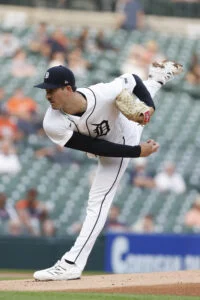
Anderson’s workload changed late in the year after Detroit traded Tarik Skubal and Casey Mize at the trade deadline. He moved into the rotation and started his final nine appearances, posting a 2.84 ERA over 44 1/3 innings. The results came with some warning signs: he struck out 20% of hitters, walked 11%, and allowed home runs at an above-average rate. He also rarely worked deep enough to face a lineup more than twice. In third trips to the plate against him, hitters went 9-for-22 with two home runs and two doubles.
Still, the overall profile makes the $10 million option understandable. Anderson averaged 95 mph on his fastball and used a curveball and kick-changeup to miss bats. He developed the changeup with the SSG Landers in Korea, and it helped him limit left-handed hitters. In relief, he struck out nearly 27% of batters; across all roles, his strikeout rate was 25%. He finished with 108 innings and a 3.67 ERA. That mix gives Detroit a pitcher who could fill a rotation opening or return to the bullpen, depending on how the staff takes shape.
The rotation picture remains unsettled. Valdez, Troy Melton and Jackson Jobe currently lead the depth chart. Anderson joins Keider Montero and River Ryan among the candidates for a back-end spot or relief work. Reese Olson could also factor in, depending on his recovery from shoulder surgery. Detroit is expected to look for rotation help this offseason, so Anderson’s role will depend in part on what the club adds.
Jansen’s option leaves a late-inning vacancy
Declining Jansen’s option buys Detroit $10 million in payroll flexibility compared with exercising it, while leaving the closer’s job unresolved. Jansen held that role throughout the season, but his 22 saves in 28 chances came alongside concerning walk and home run rates. He still struck out 28.3% of batters and finished with a 3.20 ERA in 45 innings, including 9 1/3 scoreless innings in September. The season was mixed, and the price of the option would have been steep for a reliever whose performance didn’t make the role feel secure.
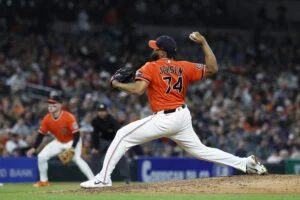
Jansen, Will Vest, Kyle Finnegan and Brant Hurter all received significant bullpen assignments early in the season, before Hurter suffered a back injury in late May. Anderson took on more responsibility as the season went on, but the group’s uneven performance leaves Detroit with substantial work to do in the high-leverage innings. Finnegan and Vest are coming off poor seasons, and Jansen’s departure removes the incumbent closer.
Jansen may prefer to find another team willing to give him the ninth inning. He’ll turn 39 next season and has 498 career saves, third-most all time. His career total puts 500 within reach early next season, though Detroit’s decision means it won’t guarantee him that milestone in its uniform. The Tigers have time to assess the market and compare him with other potential bullpen additions, including David Bednar, Adrian Morejon, Raisel Iglesias and Emilio Pagán. Whatever direction the club takes, it needs more dependable late-inning options.
Waguespack returns as roster spots open
Waguespack should compete for a middle-relief role after a productive run with Detroit. The Tigers acquired him from Milwaukee in mid-June while he was in Triple-A, then used him in 35 games. He delivered a 2.49 ERA across 47 innings, mostly in low- and medium-leverage situations. His 19.1% strikeout rate was modest, but he kept the ball on the ground at a 48% rate.
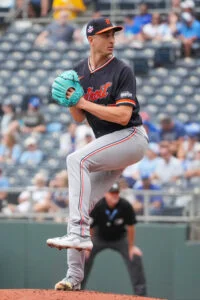
Waguespack can elect free agency after each season under a release clause he negotiated after returning from a two-year stint in Japan in 2022-23. That clause helped him secure a salary above the pre-arbitration minimum. He’s out of minor league options, so Detroit would need to expose him to waivers to send him to Triple-A. The guarantee and bonus structure give the Tigers a known bullpen contributor, while Waguespack has a clear path to a major league roster spot.
Adding Anderson and Waguespack required Detroit to clear four places on its 40-man roster. The club placed pitchers Bailey Horn and Sawyer Gipson-Long on release waivers, designated reliever Yilber Díaz for assignment and outrighted outfielder Corey Julks. Julks cleared waivers and elected free agency, according to the team.
Gipson-Long is the most notable name among the departures. After a four-start stretch as a rookie in late 2023, he underwent internal brace surgery the following April. He was healthy this past season but spent all year on optional assignment, posting a 5.50 ERA over 109 2/3 minor league innings. His strikeout rate was around league average, but he issued too many walks while working with a fastball in the 91-92 mph range. He had slipped out of Detroit’s rotation plans.
Horn had Tommy John surgery around the All-Star break and is expected to miss most of next season, making his roster spot difficult to hold. Díaz arrived on a waiver claim from Arizona in late June. He brings arm strength, but walked 15% of Triple-A hitters this year and will be out of options next season. Julks held a 40-man spot from mid-August and recorded seven major league plate appearances. His Triple-A line—.262/.337/.447 with 18 home runs—could help him find another minor league deal.
Detroit’s early moves create a useful depth option in Anderson, retain Waguespack at a manageable guarantee and free up room to reconsider the back of the bullpen. The next decisions will show whether the Tigers view Anderson as a starter, a flexible long reliever or both—and who they trust to finish games.
Respective images via Brian Bradshaw Sevald, Rick Osentoski, and Denny Medley — Imagn Images.