2026 MLB Pitching Superlatives: Mason Miller Leads the Fastball Race
Velocity tells only part of a pitch’s story, but the 2026 season supplied plenty of extremes worth celebrating. Mason Miller again led baseball in average four-seam fastball speed, Jacob Misiorowski threw the season’s fastest individual pitch, and Chris Bassitt’s curveball moved at a pace that made “slow” feel almost inadequate. The season’s oddest moments included an eephus that wandered far from home plate and a changeup that Luke Keaschall fouled off the knob of his bat.

Miller owns the fastest average fastball
Miller’s four-seamer averaged 101.4 mph, edging his own 2025 mark of 101.2 mph and giving him the Fastest Fastball distinction for a second straight season. Ben Joyce, the 2024 winner, finished close behind at 101 mph. Edgardo Henriquez placed third and fourth with two different offerings: a 100.9 mph sinker and a 100.7 mph sinker.
Miller’s fastest pitch of the season reached 104 mph. Hunter Goodman managed to hold off the tempting pitch, earning a ball despite its pace.
The distinction for the season’s fastest single pitch went to Misiorowski. His 105.5 mph four-seamer to Pete Crow-Armstrong on June 26 was the third-fastest pitch of the Statcast era. Crow-Armstrong put the bat on it, a feat worth acknowledging even without a hit.
Misiorowski also set the season’s mark for Heaviest Usage, throwing his four-seamer 1,677 times. Freddy Peralta ranked second with 1,568 four-seamers. Misiorowski’s fastball averaged 100.6 mph, making him the fastest-throwing starting pitcher in the season’s history, according to the article’s account. The numbers also settle one bit of baseball nomenclature: for purposes of these awards, Misiorowski takes the “Fastball Freddy” nickname from Peralta.
A fastball-heavy approach, with one surprising exception
José Alvarado’s pitch mix was even more concentrated. The Phillies left-hander threw a four-seamer, sinker or cutter 97.4% of the time, earning the Frequentest Fastball award. His curveball accounted for the remaining 2.6%—and can look like an unexpected weapon when it does appear.
One curveball earned Alvarado a called strikeout despite appearing nowhere near the top of the strike zone. The pitch illustrates how a rare offering can disrupt a hitter’s expectations, though the clip alone can’t explain the call.
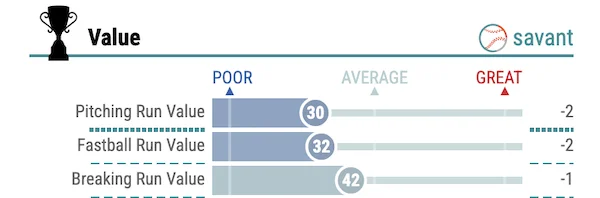
There’s an intriguing split between usage and pitch-quality measures here. Stuff+ gave Alvarado’s curveball a grade of 152, his best mark among pitches, even though he barely used it. Baseball Savant’s run values weren’t as favorable toward his cutter in 2026, while the percentile sliders on pitcher pages group fastballs together. Those measures can therefore point toward the seldom-thrown curve as his standout pitch.
The season’s slowest offerings
The Slowest Pitch honor belongs to Bassitt’s curveball, which averaged 71.3 mph. It has been among baseball’s slowest pitches for several seasons: Bassitt’s curve ranked first or second in each of the previous four years, and it finished in the top 10 in 2021 and 2022 as well. The pitch’s slow pace is a defining feature, even if its slowest example of 2026 wasn’t especially dramatic.
The slowest individual pitch was an eephus from James McCann: a 30.3 mph rainbow thrown on April 28 in a Diamondbacks-Brewers game. It came on the first pitch of the bottom of the eighth inning, during a 13-2 game. The Brewers’ broadcast was still showing a group-sales ticket promotion when McCann released it; by the time the broadcast returned to play, the ball had climbed out of frame.
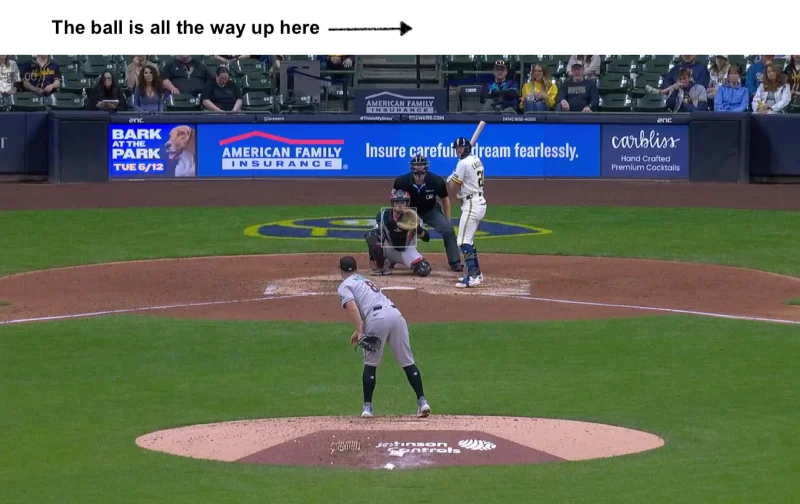
McCann’s pitch captures the spectacle of an eephus: its long, high arc makes the delivery feel almost detached from the standard rhythm of an at-bat. It’s a striking contrast to Misiorowski’s record-setting heater, yet both pitches claim a place among the season’s most memorable velocity extremes.
One eephus that missed everything
The season’s Sloppiest Pitch came from Carlos Cortes, an A’s outfielder who pitched in nine games and threw 151 eephuses. The qualification threshold for the other superlatives was 152 pitches, so Cortes missed it by one. That near miss is reason enough to make the award an exception: his eephus gets the title anyway.
The featured pitch came during a 23-2 game against the Nationals. It wasn’t Cortes’ slowest eephus, but it was his biggest miss. The ball bounced behind Jacob Young, struck a Circa Sports sign after three hops, then caromed back toward the middle of the field. Somehow, the pitcher, catcher, batter and umpire all appeared to miss the ball’s detour.

There’s a second odd detail in the clip: a white dot appears between the mound and home plate, slightly to the right. That’s Statcast’s indication of where the pitch supposedly crossed the plate. Given how far the ball actually traveled from the plate, the marker looks almost like a dry joke from the tracking system.
Carlos Cortes’ unusual season as a position player on the mound makes the cutoff itself part of the story. A one-pitch difference separates the formal threshold from his 151 eephuses, but the scale of the miss makes the result easy to remember.
Gaddis wins the changeup gap
The final velocity honor measures separation rather than raw speed. The Changiest Changeup goes to the pitcher with the largest gap between his fastest four-seamer and his changeup. Dylan Cease and Hunter Gaddis both had a 15.4 mph gap, so the tiebreaker was the slower changeup. Gaddis’ averaged 79.7 mph, compared with 81.4 mph for Cease.
Gaddis’ slowest changeup of the season produced one of baseball’s stranger contacts. Against the Twins on July 23, he left a traditional changeup so far inside that the broadcast classified it as a splitter. Luke Keaschall took the pitch off the knob of his bat and fouled it away. The ball came off the bat at 50.3 mph.
That wasn’t even Keaschall’s slowest foul ball off a Gaddis changeup. On May 9, a different changeup also clipped the knob of his bat.
Brent Suter threw the season’s slowest changeup at 76.6 mph, but the award’s gap-based rules left him out of the winner’s circle. That distinction captures the point of this set of superlatives: pitch speed is interesting on its own, but the relationship between a pitcher’s offerings can be just as revealing. The next installment turns from velocity to other extremes in pitch movement and results.