Canelo Alvarez Reclaims WBC Super Middleweight Title With Win Over Mbilli
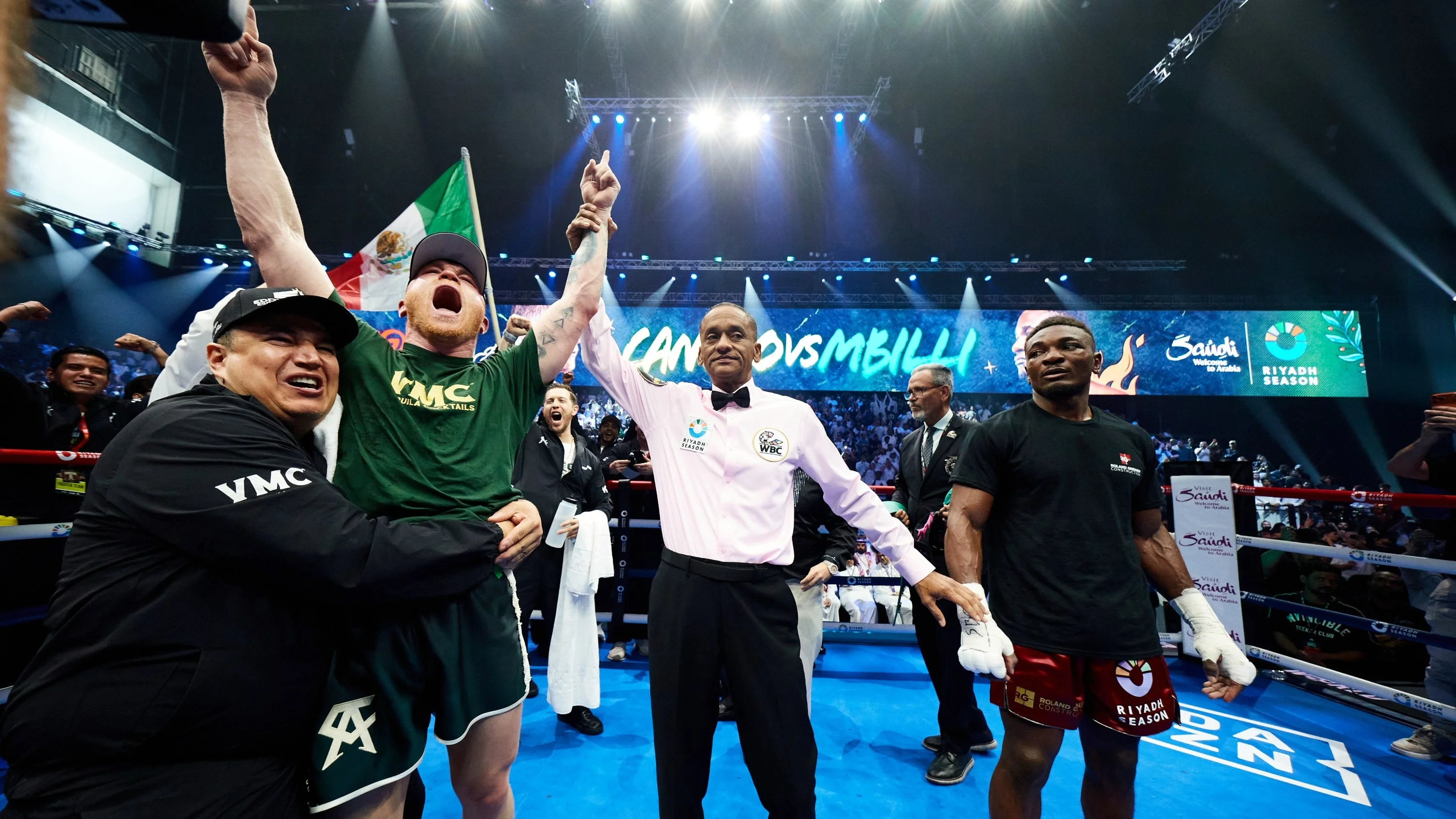
A title regained, and a question answered
Canelo Alvarez’s return to the super middleweight title picture answers the question his loss to Terence Crawford left hanging: how much championship boxing does the 36-year-old still have in him? Against Christian Mbilli in Riyadh, Alvarez absorbed an early assault, found his timing and earned a unanimous decision to take the WBC belt. The result is a clear achievement, but the way it came matters as much as the title itself: Alvarez had to weather pressure before he could make the fight look like his own.
The judges scored it 115-112, 116-111 and 117-110. Alvarez moves to 64-3-2 with 39 knockouts; Mbilli’s record becomes 29-1-1 with 24 knockouts. It was Alvarez’s first fight in 413 days, a stretch that included recovery from elbow surgery after his defeat to Terence Crawford in September of the previous year. That context makes the decision more revealing than a routine win: Alvarez had to show that his timing and ability to manage exchanges still held up after a long break.
Mbilli’s pressure gives way to Alvarez’s counters
Mbilli, 31, made the opening rounds a test of pace. He drove Alvarez toward the ropes and fired in clusters, often outworking him three punches to one. A quick right hand narrowly missed in the second, and the Frenchman kept pressing in the third with untidy but persistent flurries. His approach forced Alvarez to defend and read the entries before he could establish his own offense.
Alvarez initially invited the pressure, leaning away and searching for counters. That choice left him reacting while Mbilli set the tempo, and it took time for Alvarez to make the openings predictable. Then he began meeting Mbilli at close range. A right hand caught the champion as he stepped in, and Alvarez started advancing in the fifth, bringing a left around the guard before following with his right and visibly shaking Mbilli.
The Mexican’s left hook became a recurring problem for Mbilli, whose answer was to keep throwing in tight exchanges. Alvarez was comfortable there: at one point he landed four hooks in succession. This is more significant than it looks. The exchanges called for balance, restraint and an ability to choose shots while under pressure—qualities that can be difficult to recover after a layoff. In the seventh, he timed a forward lunge with a clean right uppercut that rocked the Frenchman. The punch marked a shift in the fight’s feel, as Mbilli’s output faded and Alvarez’s accuracy grew.
By the 10th round, Alvarez was dictating the action with his jab, mixing shots to the head and body before looping the left hook around Mbilli’s guard. The fighter who had spent the early rounds marching forward was now backing away. That change suggests Alvarez had found a rhythm that made Mbilli’s aggression less useful: the challenger still tried to initiate exchanges, but Alvarez increasingly decided where they happened and how they ended.
Mbilli tried to lift the pace in the final rounds, but his late push couldn’t erase the lead. In the 12th, Alvarez answered a flurry against the ropes with another sharp uppercut that buckled Mbilli’s legs. A late surge can make a fight uncomfortable, but it doesn’t automatically reverse the work done in earlier rounds. Alvarez had enough control built up to meet the final attack without surrendering the decision.
A meaningful return after a long layoff
Alvarez called the performance “perfect” and said winning again felt like claiming his first title. “21 years as a professional and 16 years after I won my first title – now I've won again,” he said. He plans to rest for a couple of weeks before returning to training and learning. The remark about learning is telling: even a veteran champion frames the next stage as work still to be done, rather than treating one victory as a full answer to every question about his form.
The result restores one of the four titles Alvarez lost to Crawford and gives him a persuasive answer to doubts about his future at 168 pounds. He is not the fighter he was at his peak, but this bout showed that his counterpunching, composure and body work can still trouble an aggressive younger champion. The numbers here are underwhelming as a measure of certainty: one decision, after one long absence, can show what remains, but it can’t establish how consistently he can reproduce it.
What the win means next
If you're working in this space, the useful distinction is between Alvarez’s ability to solve Mbilli and the broader question of what he can sustain. He adjusted after being outworked early, began landing cleaner counters and handled a late push. Those are concrete signs of skill and composure. They don’t erase the uncertainty that comes with a 413-day gap and a return from elbow surgery.
And yet. Alvarez has put himself back in the title picture with a performance built on adaptation, not just reputation. His early patience let Mbilli spend energy; his later accuracy turned that pressure into openings. The fight offers a practical test for any next opponent: can they keep Alvarez from settling into close-range counters, and can they maintain their own pace once he starts landing? The bout doesn’t answer those questions, but it makes them sharper.
Fight week had also been shaped by criticism of organisers SELA and Turki Alalshikh for proceeding with the event amid security concerns after missile and drone strikes targeting Riyadh in recent weeks. The contest itself stayed inside the ropes, leaving the criticism and the sporting result as separate parts of the event’s story. For Alvarez, the practical takeaway is clear: after more than a year away, he can still turn pressure into openings—and make a title fight on his terms. The next test is whether this version of Alvarez can do it again.