PFF Week 9 Quarterback Rankings: Joe Burrow Leads as Caleb Williams Cracks the Top Five
The clearest story in this week’s quarterback rankings is how quickly the middle of the pack can move. Joe Burrow remains No. 1, Caleb Williams has climbed into the top five, and Kirk Cousins’ best game of the season has bought him some breathing room as the Raiders weigh their options. Those shifts matter, but the rankings still come with judgment calls: PFF says they account for prior performance as well as grades, and the sample remains small enough to punish overreaction.
Welcome to PFF’s Week 9 quarterback rankings. The list puts more weight on this season’s work than earlier editions did, while still balancing it against what came before. Quarterbacks sidelined for a significant stretch because of injury are left out; their backups take their places.
The top of the list
1. Joe Burrow, Cincinnati Bengals (unchanged)
Burrow keeps the top spot after another high-level showing against the Titans. He produced five big-time throws, a season high for the second week in a row. He also set a season high with his turnover-worthy plays, but recovered well enough to post a 92.3 PFF passing grade.
2. Josh Allen, Buffalo Bills (up 1)
Allen’s recent stretch has changed the shape of his season. Across his first five games, he had five big-time throws and 10 turnover-worthy plays. In the past two, he has four big-time throws and just one turnover-worthy play.
3. Brock Purdy, San Francisco 49ers (down 1)
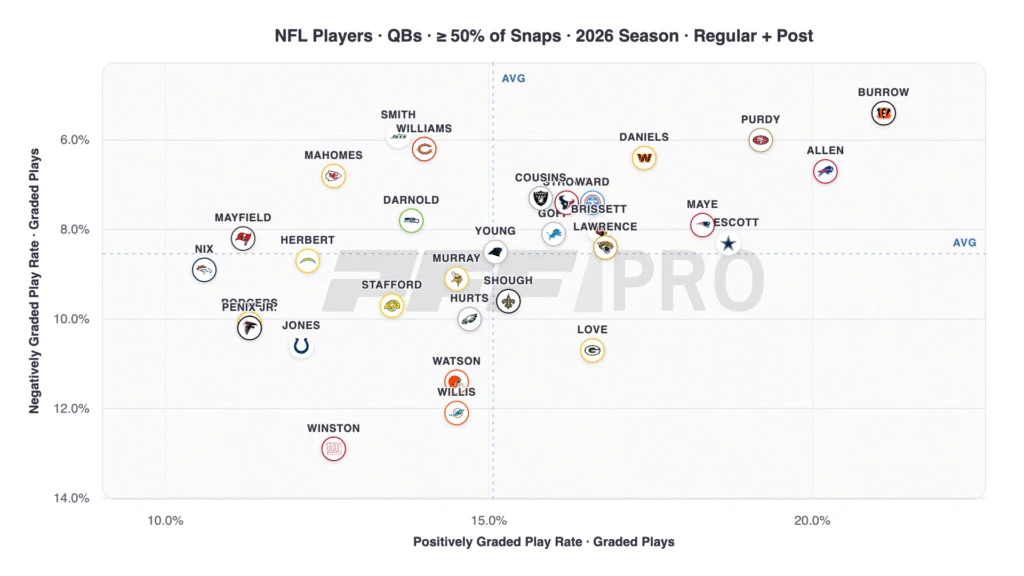
San Francisco had a bye in Week 8, so Purdy’s latest evidence is the loss to the Atlanta Falcons. It was his poorest game of the season: no big-time throws and three turnover-worthy plays, both season extremes. One bad outing hasn’t erased the broader picture. His 19.2% positively graded play rate ranks sixth, while his 6.0% negatively graded play rate is the league’s third-lowest.
4. Drake Maye, New England Patriots (up 2)
Maye’s start and finish to the first half of the season look like two different stories. He graded below 55.0 in each of New England’s first three games, then cleared 75.0 in all five contests since. From Week 4 onward, he leads every quarterback in both overall PFF grade and passing grade.
5. Caleb Williams, Chicago Bears (up 4)
Williams is back from injury and has made the top five on the strength of two sharp games. His 83.7 passing grade over that span ranks fourth among quarterbacks, and he’s playing the best football of his career. A 1.5% turnover-worthy play rate—tied for third-best in the league—would be a career best if he sustains it.
6. Jared Goff, Detroit Lions (down 1)
Goff threw his first interception of the season against Minnesota, despite having no turnover-worthy plays in the game. The distinction is a useful reminder that interceptions and PFF’s turnover-worthy play measure aren’t interchangeable. His 81.8 passing grade is tied for third this season, and his 1.8% turnover-worthy play rate is tied for sixth-best.
7. Dak Prescott, Dallas Cowboys (down 3)
Prescott graded above 70.0 for the seventh time in eight games in Sunday’s loss to the Arizona Cardinals. The performance came with just 195 passing yards, his second-lowest total of the season. Through eight games, he has 14 big-time throws and nine turnover-worthy plays.
8. C.J. Stroud, Houston Texans (no change)
Stroud and Houston were off in Week 8. His most recent outing, against the New York Giants in Week 6, was his lowest-graded game of the season; he threw for 153 yards. Even so, his season-long rates for both big-time throws and turnover-worthy plays remain among the league’s top three.
9. Jordan Love, Green Bay Packers (up 2)
Love responded to a setback against the Detroit Lions with a solid Thursday-night win over the Carolina Panthers. He finished with a 76.3 PFF grade, two big-time throws and three turnover-worthy plays. The rebound was real; so was the risk.
10. Trevor Lawrence, Jacksonville Jaguars (up 2)
Lawrence’s 69.7 grade in the win over the Indianapolis Colts was his second-best of the season, behind only his 86.0 in Week 1 against the Cleveland Browns. He added another turnover-worthy play, though, and his 5.5% rate is the fourth-worst in the NFL. That’s the clearest concern in an otherwise improved outing.
Movement in the middle
11. Jayden Daniels, Washington Commanders (up 3)
Daniels has cleared a 70.0 PFF grade in each of his five starts, though he hasn’t yet reached 80.0 in a game. Among quarterbacks with at least 150 dropbacks, his 1.1% turnover-worthy play rate ranks second-best. The trade-off is limited aggression: his 2.6% big-time throw rate is fourth-worst.
12. Patrick Mahomes, Kansas City Chiefs (down 5)
Mahomes has followed the reverse of Drake Maye’s trajectory. He opened the season with a 91.4 grade, second-best among quarterbacks through three weeks, but has fallen to 23rd with a 58.0 grade since Week 4. Over his past three games, he has one big-time throw and four turnover-worthy plays. That’s a sharp enough drop to explain his slide.
13. Bryce Young, Carolina Panthers (down 3)
Young’s recent production has cooled. He opened with eight big-time throws and one turnover-worthy play across four games; in the past three weeks, he has two of each.
14. Geno Smith, New York Jets (up 6)
Smith’s 80.9 season grade ranks eighth among quarterbacks, and his play has started to resemble his time with the Seattle Seahawks. His 5.4% big-time throw rate is tied for fourth-best; his 2.0% turnover-worthy play rate ranks eighth-best.
15. Kirk Cousins, Las Vegas Raiders (up 10)
With questions growing about whether Las Vegas should turn to No. 1 overall pick Fernando Mendoza, Cousins delivered his strongest performance of the year. He graded at 90.3 in Sunday’s win over the Jets. He has seven turnover-worthy plays on the season and hasn’t recorded more than one in a game since Week 1. One big game doesn’t settle the quarterback question, but it gives the Raiders a reason to wait.
16. Cam Ward, Tennessee Titans (up 7)
Ward’s 85.6 grade in Sunday’s loss to the Cincinnati Bengals was the second-highest of his career. He completed 26 of 40 passes for 303 yards and two touchdowns. The performance gives Tennessee a stronger case to build around him in the second half of the season than to look for a replacement.
17. Matthew Stafford, Los Angeles Rams (down 4)
Eight games provide enough evidence to question whether Stafford will approach last season’s MVP form. Through the first eight weeks last year—seven games—he had 19 big-time throws and seven turnover-worthy plays. This season, after eight weeks, the tally is 10 and 13. The comparison is stark, though it still comes from a limited sample.
18. Aaron Rodgers, Pittsburgh Steelers (down 1)
Pittsburgh’s offense doesn’t need Rodgers to recreate his peak years. His 2.9% big-time throw rate is tied for fifth-lowest in the NFL, but he’s protecting the ball: a 1.8% turnover-worthy play rate is tied for sixth-best.
19. Kyler Murray, Minnesota Vikings (down 1)
Murray’s role in Minnesota resembles Rodgers’ in Pittsburgh: the offense can function without asking him to carry it. Still, the Vikings’ first loss has prompted questions about what Murray adds. His 1.5% turnover-worthy play rate is tied for fourth-best in the NFL, and that ball security may be enough for a team with this defense to reach the playoffs.
20. J.J. McCarthy, New York Giants (up 1)
The Giants had a Week 8 bye, but McCarthy’s Week 7 win over the Houston Texans offered a promising snapshot. He went 20-for-28 for 252 yards, with three big-time throws, no turnover-worthy plays and a +10.4% Completion Rate Over Expectation. He’s already made the acquisition look worthwhile for John Harbaugh’s team.
The lower half: risk and opportunity
21. Sam Darnold, Seattle Seahawks (down 6)
Darnold has graded above 70.0 in only two games this season and has managed a turnover-worthy play-free outing just once. After four straight seasons below a 4.0% rate, he’s tracking toward 4.7%—worse than any single-season mark he posted with the New York Jets.
22. Tyler Shough, New Orleans Saints (down 6)
The Saints had a bye in Week 7, but Shough’s latest game was a 56.2-grade loss to the Pittsburgh Steelers in Paris. After going without a big-time throw in each of his previous two games, he had two against Pittsburgh. He also had two turnover-worthy plays, matching his season high.
23. Bo Nix, Denver Broncos (up 1)
Denver beat the Kansas City Chiefs, but Nix still graded below 60.0 for the sixth time in eight games. His season rates offer little comfort: a 2.9% big-time throw rate is tied for fifth-lowest, while his 4.4% turnover-worthy play rate is seventh-worst.
24. Baker Mayfield, Tampa Bay Buccaneers (up 2)
Mayfield has returned from injury but has attempted only 14 passes across two weeks. He went 0-for-3 against the Atlanta Falcons and still outplayed the other passer. The conditions made the game a poor basis for judging either quarterback.
25. Michael Penix Jr., Atlanta Falcons (down 3)
Sunday’s weather in Florida made life difficult in the Falcons’ loss to the Tampa Bay Buccaneers, but Penix’s numbers were still damaging: 8-for-24 for 125 yards, with six turnover-worthy plays, four of them intercepted. His 7.1% rate is now the worst among quarterbacks in 2026.
26. Gardner Minshew, Arizona Cardinals (unranked)
Minshew replaced Jacoby Brissett in Sunday’s win over the Dallas Cowboys and has since been named the starter. He completed 17 of 23 passes for 188 yards and three touchdowns, earning an 84.6 PFF grade. He also had three big-time passes and no turnover-worthy plays. That’s a strong first case for keeping the job.
Late in the rankings, the warning signs pile up
27. Deshaun Watson, Cleveland Browns (no change)
Watson’s loss to the Pittsburgh Steelers produced his third-lowest grade of the season. The deeper issue is how often his dropbacks leave the offensive line exposed: he leads the NFL with 27 attempts that began at least 11 yards behind the line of scrimmage, and was sacked on five of them. That sack total is also the league’s highest. This is more than a protection problem; the depth of the dropback is part of the equation.
28. Malik Willis, Miami Dolphins (down 1)
Willis slipped one spot after a poor outing against the New England Patriots, his third-worst graded game of the season. He completed 21 of 32 passes for 211 yards, two scores and an interception, earning a 61.6 PFF grade. The efficiency numbers offer little reassurance: his 4.6% turnover-worthy play rate ranks sixth-worst, and his 3.0% big-time throw rate is tied for the seventh-lowest.
29. Tanner McKee, Philadelphia Eagles (up 1)
McKee’s third start ended with a 62.6 grade after he went 23-for-34 for 212 yards, no touchdowns and one interception. Across those three starts, he has kept turnover-worthy plays to a 1.5% rate. But his big-time throw rate is only 1.7%, a profile that suggests caution more than playmaking.
30. Justin Herbert, Los Angeles Chargers (down 1)
Herbert has recorded at least one turnover-worthy play in every game through seven appearances, and three such plays in five of them. He’s playing the worst football of his career. The harder question is what this season’s slide could mean for his NFL future; the available numbers show the downturn, but don’t settle how lasting its consequences will be.
31. Daniel Jones, Indianapolis Colts (no change)
Jones has 20 turnover-worthy plays through Week 8 of the 2026 season. Since PFF began grading games in 2006, only two quarterbacks have matched or exceeded that total through eight weeks; the figure is tied for third-most overall. It’s also the highest first-eight-week total since Carson Wentz reached 20 in 2020. That’s a grim benchmark for a quarterback whose ranking hasn’t changed.
The backups
32. Joe Fagnano, Baltimore Ravens (unranked)
Fagnano, an undrafted free agent, is now Baltimore’s starter after both Lamar Jackson and Tyler Huntley were injured in Sunday’s loss to the Buffalo Bills. He flashed a couple of big plays early, then finished with a 38.4 PFF grade. His next assignment comes Thursday night against the Jacksonville Jaguars, described here as one of football’s best defenses. That’s a severe test for a player thrust into the starting job by injuries, and the early flashes will need to become something more if Baltimore is to get a steadier performance.