An 8-0 Fantasy Football Team Fueled by Elite Running Backs and Trey McBride

| 5 min read

An 8-0 start has turned a promising draft into a runaway lead

The story has changed quickly. Four weeks ago, the 10-team superflex roster built mostly with PFF’s Live Draft Assistant was unbeaten at 4-0, but two wins had come by just 2.62 points combined. Now it’s 8-0, has scored a league-leading 1,394.46 points, and sits three games ahead of its closest rivals. Each of the latest four victories came by at least 27 points. The early suggestion that luck might be doing some of the work hasn’t aged well.

That record has a few clear foundations. D’Andre Swift, Kyren Williams and Jonathan Taylor rank third, fourth and sixth among running backs in standard PPR scoring through Week 8. Late-round quarterbacks have also kept the lineup afloat while Lamar Jackson has been absent: 11th-rounder Tyler Shough is QB11, and 18th-rounder Geno Smith has supplied useful starts.
Our previous look at the roster came after that 4-0 start, when narrow margins made caution sensible. The current run is harder to dismiss. I took Jackson at pick 1.09, then let the assistant shape most of the remaining draft. The league uses superflex scoring and awards an extra half-point for each tight end reception; the team totals below reflect those rules, while individual player rankings and points use standard PPR scoring.

Three top-six running backs

The roster’s clearest advantage is in its backfield. Taylor and Williams were early picks, but ninth-round selection D’Andre Swift is what made the group unusually deep. Swift has 154.7 PPR points (RB3), Williams has 154.0 (RB4), and Taylor has 150.2 (RB6). That’s enough firepower to put another high-end back in the flex each week.

Swift’s 10 rushing touchdowns lead the league, so some regression is a reasonable concern: he has outscored his 133.7 expected points. Still, the opportunity is real. His 19 carries inside the 5-yard line rank second among running backs. The touchdown pace may not last, but it hasn’t come from thin air.

Taylor’s 610 rushing yards and eight scores are broadly in line with his 146.5 expected points. Williams brings a different contribution, adding 33 catches for 242 yards to 548 rushing yards. The assistant spent early picks on the position and found a third starter later. That depth has helped compensate for trouble at quarterback.
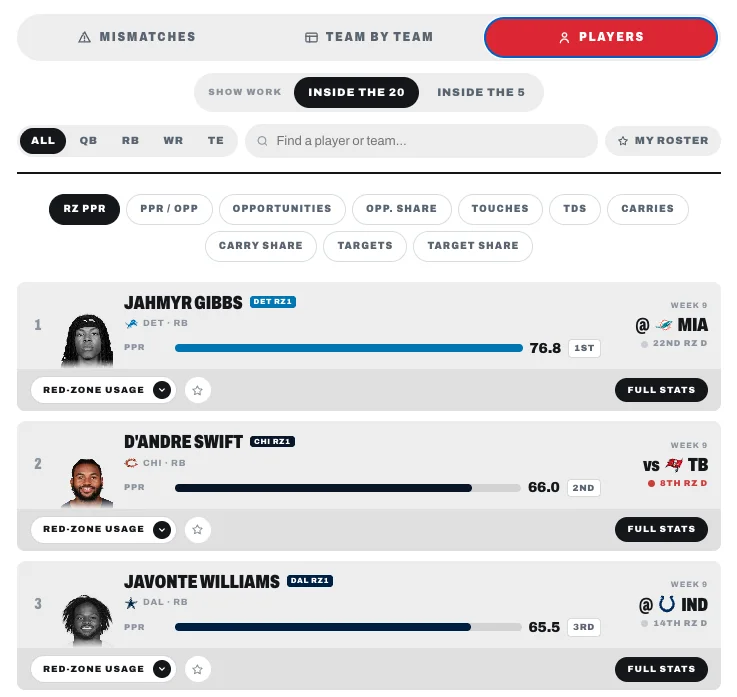
Click here for the PFF Red Zone Report!

Trey McBride keeps paying the premium

A third-round pick on McBride has delivered a weekly edge at tight end. He leads the position with 150.4 standard PPR points, 82 targets, 66 catches and 21 red-zone targets. Those receptions are worth another 33 points in this league’s tight end premium, bringing his roster total to 184.4—the highest on the team.

He has kept producing despite the quarterback uncertainty. McBride’s 33.1 league points in Week 7 helped push the roster to its season-best 203.43. Paying up for that kind of target volume has made one lineup decision unusually simple.


Late-round quarterbacks have covered the gaps

Jackson was the first-round bet, and his absence is the roster’s obvious weak point. The eighth-round pick on Kyler Murray hasn’t paid off: he has 74.6 points, ranks QB30, and has thrown five touchdowns in six appearances.

Shough has been a much better return on draft capital. The 11th-rounder has 137.9 points, good for QB11, and averages 19.7 points per game against 20.3 expected. That gap is small enough to suggest his results have tracked his opportunities.

Smith, taken in Round 18, has added 126.1 points and ranks QB15. He has started each of the past three weeks, scoring 25.23 league points in Week 7 and 19.25 in Week 8. The team even absorbed a zero from Jackson in Week 8 and still won by 71.51 points. Depth has done its job. Whether Jackson returns is another matter: with the Baltimore Ravens quarterback potentially out for the season, a healthy version of this roster may be hard to get back.

NFL Quarterbacks
Week 1-8
2.0%4.0%6.0%Big Time Throw %2.0%4.0%6.0%8.0%Turnover Worthy Play %AVGAVG
Burrow
Jackson
Prescott
Purdy
Allen
Goff
Maye
Stroud
Smith
Daniels
Young

Big throws and risky decisions tell different stories

The chart’s useful signal is how sharply quarterback aggression separates from ball security. Joe Burrow pairs a 6.1% Big Time Throw rate—the second-highest among 35 quarterbacks—with a 2.3% Turnover Worthy Play rate, ranked 13th. Lamar Jackson is close behind in big throws at 5.6% (fourth), while his 2.4% turnover-worthy rate ranks 14th. That combination matters more than either number alone: both are creating difficult, high-value throws without sitting near the top of the mistake list. Dak Prescott’s profile is steadier: a 4.3% big-throw rate, 11th of 35, and a 2.5% turnover-worthy rate, 15th. The gap between those figures and the leaders is modest, which makes the chart more useful for comparing styles than declaring a single best quarterback. The wider field shows why. Patrick Mahomes and Tyler Shough each post 4.1% Big Time Throws and 2.2% Turnover Worthy Plays. Jordan Love reaches 5.4% on big throws but also records 4.2% turnover-worthy plays. Trevor Lawrence’s 4.7% big-throw rate comes with a 5.3% turnover-worthy rate; Michael Penix Jr. combines 3.9% with a notably high 7.1%. Those pairings suggest that aggression can come with a cost, though the chart alone can’t explain the circumstances behind each play.

Use the comparison as a starting point

A few other profiles underscore the trade-offs. Jalen Hurts has a 5.0% Big Time Throw rate and 2.6% Turnover Worthy Play rate, while Sam Darnold matches the 5.0% big-throw figure but has a 4.7% turnover-worthy rate. Caleb Williams and Kyler Murray are both at 1.5% for turnover-worthy plays, with big-throw rates of 3.6% and 3.0%, respectively. At the other end, Tyler Huntley records a 0.9% big-throw rate alongside a 2.9% turnover-worthy rate. If you’re comparing quarterbacks, don’t read either metric as a verdict. The chart captures frequency, not game situation or outcome, and the sample represented here includes 35 players. The same players and measures can also be sorted in the Leaders tab for each team. Source: Premium Stats Pro.

Efficiency and aggression don’t always travel together

C.J. Stroud’s numbers offer the clearest balance in this group: Houston’s quarterback ranks third among 35 in both big-time throw rate (5.9%) and turnover-worthy play rate (1.4%). Drake Maye leads the first measure at 6.4%, though his 3.7% turnover-worthy rate ranks 21st. The gap is a useful reminder that high-end throws can come with added risk. Jayden Daniels and Bryce Young show the reverse profile. Daniels has a 1.1% turnover-worthy play rate, second-best, while his 2.6% big-time throw rate sits 29th. Young leads all 35 in avoiding turnover-worthy plays at 1.0%, but his 3.5% big-time throw rate ranks 22nd. Those figures point to caution and ball security; they don’t, on their own, explain the quarterbacks’ overall performance. The rest of the field falls between those poles. Brock Purdy posts a 4.5% big-time throw rate (10th) and a 2.9% turnover-worthy rate (19th). Jared Goff pairs a 4.3% rate on big-time throws (11th) with a stronger 1.8% turnover-worthy rate (seventh). Geno Smith is fifth in big-time throws at 5.4% and ninth in turnover-worthy plays at 2.0%. Josh Allen’s 3.9% big-time throw rate ranks 17th, while his 4.2% turnover-worthy rate ranks 25th. Kirk Cousins and Caleb Williams each record a 3.6% big-time throw rate, tied for 20th; Cousins’ 2.1% turnover-worthy rate ranks 10th, compared with Williams’ 1.5%, fourth-best. Patrick Mahomes lands 14th in big-time throws at 4.1% and 11th in turnover-worthy plays at 2.2%. The takeaway is less about crowning one style than seeing the trade-offs. If you’re comparing quarterbacks, these two rates help distinguish aggressive playmaking from mistake avoidance, but they can’t settle the larger question of who played best.
Source: Ryan Conway · www.pff.com