‘Rocky’ and ‘I Play Rocky’: Two Underdog Stories, One Boxing Legacy
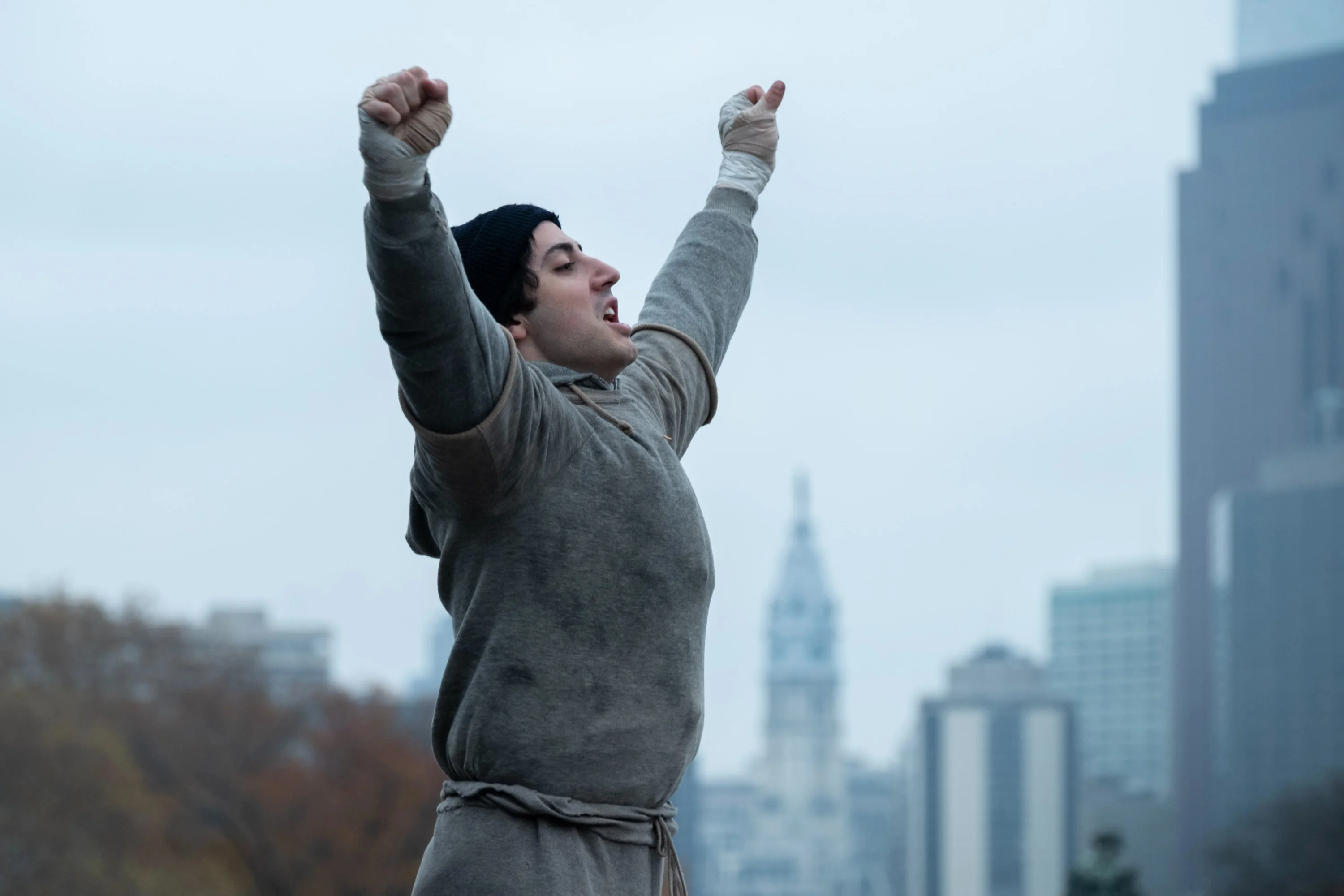
The neatest trick in “I Play Rocky” is that it asks viewers to reconsider what made “Rocky” endure. Boxing supplies the fights, training and stakes, but director Peter Farrelly sees the 1976 film as just as much a character drama: a story about a decent, struggling man who gets an unlikely chance to prove what he can do.
That distinction gives the new film its own identity. “I Play Rocky” follows Sylvester Stallone’s push to star in the film he wrote, a familiar underdog premise that doesn’t depend on suspense about the outcome. The audience knows “Rocky” will get made, become a hit and launch a franchise. The challenge is making the struggle along the way feel alive.
Boxing is the frame, not the whole story
In a scene in “I Play Rocky,” John G. Avildsen, played by Jay Duplass, discusses directing the film with Stallone, portrayed by Anthony Ippolito, and producers Irwin Winkler and Robert Chartoff, played by P.J. Byrne and Toby Kebbell. Avildsen argues that the project shouldn’t be treated primarily as a boxing movie. It’s a pointed idea for a film centered on one of cinema’s most famous fighters.
Farrelly’s answer is less categorical. “I think ‘Rocky’ — it's both,” he said. “It's a boxing movie, definitely — it’s the boxing movie. But it is also a character piece.” He added that “Rocky” is more of a boxing movie than “I Play Rocky.”
The distinction tracks. The 1976 film begins and ends with bouts, and its training scenes have become part of the sport’s screen vocabulary. But the fights matter because of what they mean to Rocky Balboa, a man trying to turn a rare opportunity into a sense of self-worth. The romance, the Philadelphia setting and the film’s Thanksgiving and bicentennial backdrop all help make the story larger than its ring.
“I Play Rocky” has boxing in its cast’s preparation and in the story it tells about the making of the original. Its central contest, though, is Stallone’s effort to convince the people around him that he should play the title role. That makes it an underdog story with a different arena.
A familiar ending, a demanding performance
Because the broad outcome is already known, the film has limited room for conventional suspense. Its dramatic energy has to come from the setbacks, negotiations and personal resolve that lead to the finished movie. Screenwriter Peter Gamble and Farrelly make that known destination work as a source of momentum rather than a dead end.
Ippolito gives the project a persuasive center. Born in 1999, he is far removed from the audience that first encountered “Rocky” in theaters. His own early memory of the franchise comes from seeing “Rocky Balboa” on the big screen when he was seven. Yet he carries an unusual connection to 1970s movie history: in the Paramount+ series “The Offer,” he played a young Al Pacino during the making of “The Godfather.”
Farrelly said Ippolito’s audition made the casting decision immediate. He had watched “The Offer” but didn’t recognize Ippolito when they began working together on “I Play Rocky.” The actor’s ability to disappear into the part had already made an impression before Farrelly realized he had seen him play Pacino.
Playing Stallone asked more of Ippolito physically than his earlier role. He had to add muscle and change a build Farrelly compared to De Niro’s transformation for “Raging Bull.” Ippolito and Stephan James, who plays Carl Weathers, also trained at Gleason’s Gym in Brooklyn. Their goal was to look like boxers in the making, matching the early stage of Stallone’s own experience in the ring.
Casting carries the story
The supporting cast helps the film evoke the people around the original production. Robert Morgan plays Burgess Meredith, Scot Teller plays Burt Young, and Kiko Seto plays Talia Shire. Duplass brings a focused presence to Avildsen, while AnnaSophia Robb plays Stallone’s first wife, Sasha.
Tracy Letts stands out as studio executive Sandy Maddox, a fictional composite of executives who preferred someone other than Stallone for the lead. Matt Dillon, despite being the film’s most prominent name, takes the smaller role of Stallone’s father. The ensemble’s resemblance to the people it depicts is part of the pleasure, but the performances also give the familiar production story a human scale.
The film isn’t without awkward choices. Some events are reshaped for dramatic effect, and a flattering moment about Stallone’s anatomy risks feeling like an unusually conspicuous effort to win the real-life actor’s approval. Knowing the destination also imposes a ceiling on the tension. These are noticeable limits, even if they don’t undo the film’s appeal.
A Rocky story with a different kind of fight
Farrelly remembers seeing “Rocky” in 1976 after reading a review in Newsweek. The movie wasn’t an immediate first-weekend phenomenon, he recalled; its audience grew through word of mouth. He left the theater energized without knowing exactly what he wanted to do with that feeling, then urged his friends to see it. For him, it made a deeper impression than “Star Wars” and other major releases of the period.
That response helps explain why Farrelly wanted to make “I Play Rocky.” Ippolito called the film “a love letter to what [Stallone] was able to achieve,” and Farrelly’s memories give that sentiment a personal basis. The new film is not just revisiting a hit; it’s tracing the stubborn effort that got the hit made.
The original “Rocky” won Best Picture over “Taxi Driver” and “All the President’s Men,” a decision that remains open to debate. Its staying power is less contentious. The sequels have divided fans: some embrace the heightened style of “Rocky III” and “Rocky IV,” while others prefer “Rocky II” or the grittier first half of “Rocky Balboa.” Each has its supporters and its weak spots.
Against that uneven run, “I Play Rocky” makes a credible case as the strongest Rocky-related film since the original. Whether it belongs in the franchise is a matter of definition. It has no Balboa fight to win, but it understands the drive that made his story resonate. Its best invitation may be the simplest one: watch it, then return to the 1976 film and see how the two underdog stories speak to each other.