Diego Pacheco Bets His Jab and Patience on a 168-Pound Push
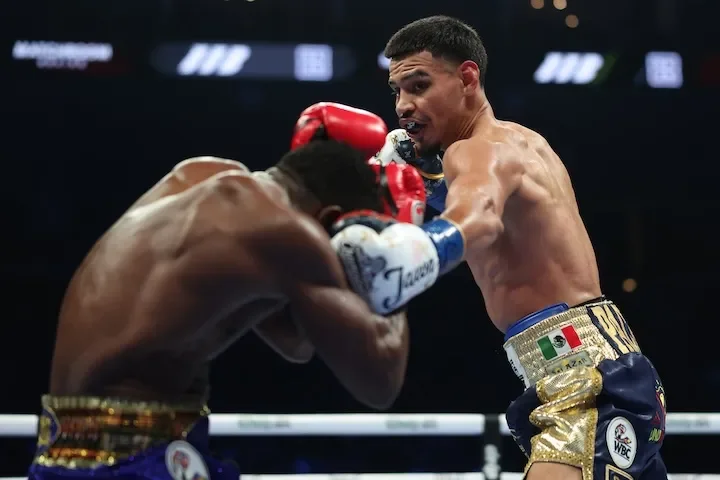
Pacheco's jab is the most underrated weapon at 168 pounds, and this Saturday in Carson, California, it gets a stage. The 25-year-old headlines a DAZN card for the fifth time in as many events, facing WBA No. 4 contender Darius Fulghum, 15-1-1 (13 KOs), at Dignity Health Sports Park. Pacheco arrives at 26-0 with 19 knockouts, a 79-inch reach, and a 6-foot-4 frame built to keep opponents at the end of a long punch.
A Jab With a Job to Do
Fans who watch Pacheco for the power will miss the point. His trainer, Hall of Fame fighter Buddy McGirt, sees the jab as the foundation of everything else. It holds foes off, it scores on the cards, and it sets up what comes next. The trouble is that a young fighter with a reach advantage and a hard right hand is always tempted to skip the setup and look for the finish.
McGirt spends a lot of time on that temptation. He starts by explaining the punch, then asks Pacheco a simple question about the first thing boxers learn. The answer is the jab, and the lesson is that it's a defensive tool as much as an offensive one.
"The jab can get you out of trouble, and if you don't use it, it can get you in trouble," McGirt said. "Look at Larry Holmes: heavyweight champion for 7½ years, and his biggest asset was his jab. You can do so much with the jab. Once you get the guy dancing to your beat, he's done."
That's the part people underestimate. A jab that's thrown with purpose changes an opponent's footwork, shortens his options, and gives a fighter a read on the next exchange. McGirt's point is that Pacheco doesn't just throw it. He chains it into other shots and uses it to control distance, which is why the trainer rates it ahead of most of the division's elite.
Where the Patience Came From
Pacheco's discipline doesn't come from a boxing manual. He grew up in South Central Los Angeles, the child of immigrant parents who arrived as teenagers with nothing, and he learned early that wanting things and asking for them were two different problems.
"Being the child of immigrant parents who came here with nothing as teenagers, with no family, I witnessed their struggle and it molded me to who I've become," Pacheco said.
He describes watching friends show up in new shoes and new gear. He didn't ask his parents for the same, because he knew what it would cost them to say no. Instead, he made a private promise that he would buy those things himself one day. That promise turned into a habit of waiting, and the waiting turned into a kind of pressure he now treats as fuel.
"That put a chip on my shoulder – that I'd put them through all this for me to lose," Pacheco said. "The pressure was on, and I rose to the occasion."
The amateur years carried the same weight. His parents went into debt to pay for his travel and tournament entry fees. Pacheco won eight national tournaments and lost only five fights in total, four of them by split decision. Those numbers say something about how close he was forced to fight, and about how he learned to win the close rounds that decide a career.
The Fulghum Problem
Fulghum is not a soft opponent. He's coming off a loss to WBA No. 1 contender Bektemirt Mulikuziev and has drawn once in his last three fights, so this is a must-win night for him. He believes his own jab is as effective as Pacheco's, and he'll try to make this a technical fight rather than a shootout. That's a sensible plan, and it puts pressure on Pacheco to prove his jab is better in practice, not just in a coach's description.
Pacheco doesn't seem worried. He says the sparring has transferred well, and that the team has been working on throwing the jab in different patterns and setting up combinations behind it. "The jab's one of my best punches, and we're throwing it different ways, setting stuff up behind it. It's a key."
He also knows what this night means. "Saturday is everything to me. Without a win, we can forget about it. I'm ready to showcase my skills at the highest level, take care of business and go from there."
Rankings, Rivals, and the Clock
Pacheco sits at No. 2 in the WBO, waiting on the Janibek Alimkhanuly and Jacob Bank title fight, and at No. 5 in the WBA behind the Jaime Munguia mandatory defense against Mulikuziev. Those positions matter, but they also explain why he's careful about his rising stature. A single loss could reshuffle everything he's worked toward.
The main event also gives him a chance to make a case for bigger fights. His last outing was a stoppage of Immanuwel Aleem in the 11th round, and it came one fight after unbeaten Lester Martinez went the distance with Aleem. Pacheco wants Martinez next, and he has a specific pitch.
"I always want to make a statement. Lester is a great fighter with a great fan base here in L.A., and a fight between us here in L.A. would be amazing," Pacheco said. "I spoke briefly with [promoter] Eddie Hearn, seeing if we can get that fight, and he said it'd be an amazing fight to make at Crypto.com Arena, so hopefully [Martinez's team] want to make that fight."
McGirt has his own opinion on that matchup. He said he would pick Pacheco to win if they fought, a confident read from a trainer who has spent years around the top of the division. McGirt previously worked with former unified middleweight champion Alimkhanuly, so he knows what top-level 168-pound boxing looks like from the inside.
Time is the other card Pacheco holds. McGirt and Hearn have both reminded him that it's on his side. He's 25, and most of the division's best are in their 30s. He doesn't see that as a race so much as a comparison.
"A lot of the top guys are in their 30s. I'm 25. I feel I have enough time to get to them all," Pacheco said. "I've looked at them and asked, 'Who were these guys fighting at 25? Not the guys I'm fighting.' I'm on a great pace and a great track."
He's also clear about the goal beyond the next win. "The main thing is we don't want to just get there. We want to get there and take over and stay for years, and I feel I'm ready to take over the 168lbs division."
Coming Home to Fight
Pacheco trained for five years in Renton, Washington, and his decision to return to Los Angeles says as much about his priorities as any ranking does. The neighborhood he left behind is rough, the roads are rough, and none of that changes how he sees the place. He talks about it as home.
"Being here reminds me of all the hard work I've put in. I love being here. A lot of the decisions I've made have been about wanting to be back here after training in Renton, Washington, for five years," he said.
His parents were the main reason for the move. "I noticed my parents getting older, and wanted to come back. I felt it was time to be my own man. Building my name here, becoming the fighter I'm destined to be, that's why I'm here."
That's the real story on Saturday. Pacheco isn't trying to escape his beginnings. He's trying to earn the kind of career that lets him stop waiting, and his jab, his patience, and his stubborn sense of timing are the tools he's using to do it. If he beats Fulghum the way McGirt expects, the next question won't be whether he's ready for a bigger fight. It will be which one he chooses.