White Sox Bet $52.5 Million on Dustin May’s Power and Upside
The White Sox are paying for a version of Dustin May they haven’t consistently seen in the majors. Their reported three-year, $52.5 million agreement with the right-hander bets that his high velocity and former top-prospect pedigree can translate into a more reliable middle-of-the-rotation starter. At 29 next season, May still has time to make that bet pay off. His recent results and injury record make the price a sizable commitment.
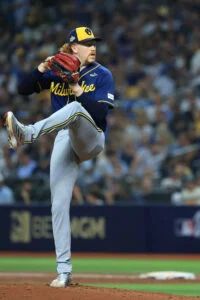
The deal hasn’t been officially announced by the team. May, represented by Paragon Sports International, is coming off a 2026 season that began with St. Louis and ended in Milwaukee. The Cardinals traded him and reliever JoJo Romero to the Brewers at the deadline after signing May to a one-year, $12.5 million contract.
Velocity is the bet
May’s fastball profile remains compelling. His four-seam fastball averaged 96.9 mph in 2026, while his sinker averaged 96.6 mph. He also throws a 93.3 mph cutter, an 86 mph slider and a changeup in the low 90s. That mix gives Chicago a foundation to work with, particularly if the club believes it can help him miss more bats.
The gap between his raw stuff and his strikeout results is the central question. May struck out 22.2% of opponents across the past two seasons, close to average, while walking 8.8% and generating ground balls on 42% of balls in play. Those are serviceable rates, but they don’t describe a pitcher dominating hitters with the kind of velocity he brings.
There was a more encouraging stretch earlier in his career. Across 53 innings in 2021 and 2022, May struck out 29.1% of batters and produced a 13.4% swinging-strike rate. In the three seasons he has pitched since then, those figures fell to 21.6% and 8.7%, respectively. The second number is particularly telling: hitters have made contact more often, limiting the payoff from his power arsenal.
May’s underlying run-prevention measures offer some reason for optimism. His FIP was 4.08 over 2025 and 2026 combined, compared with a 4.82 ERA across 278 innings in that span. His SIERA over those two seasons was 4.22. In 2026 alone, the figures improved to a 3.63 FIP and 3.99 SIERA, even as his final ERA stood at 4.70.
Those metrics suggest his earned-run totals may overstate how poorly he pitched, but they don’t erase the uneven results. May posted a 5.65 ERA in 10 starts for Milwaukee, covering 36 2/3 innings, and struggled in the postseason. He finished the regular season with a career-high 145 2/3 innings; his total including the playoffs was 156 2/3, with a 4.77 ERA.
Durability remains a real concern
The workload mark is meaningful because May has exceeded 56 major league innings in a season only twice: in 2025 and 2026. Tommy John surgery in 2021 kept him out for much of 2022. A torn flexor tendon ended his 2023 season, and the recovery, followed by surgery for an esophageal tear, cost him all of 2024.
Chicago is therefore buying more than a rebound in performance. It’s also betting May can keep taking the ball. His two most recent seasons show he can handle a fuller schedule, but that track record is short, and his medical history makes availability part of the contract’s risk.
There’s a useful comparison in Jack Flaherty, who reached free agency at 29 after putting up stronger results and showing greater durability. May brings more velocity, a distinction the White Sox appear to value. Another cautionary comparison is Taijuan Walker, whose market deal reflected his former prospect standing and relatively young age without delivering the expected return. May’s profile could break either way, but the fastball gives Chicago a specific reason to make the wager.
A rotation with room to change
May joins a staff that has options but little certainty. Sean Burke, Davis Martin, Anthony Kay and Luis Castillo are among the candidates, while Grant Taylor is being converted from relief. Young left-hander Noah Schultz and right-handers David Sandlin and Tanner McDougal have each had at least a brief major league look.
Shane Smith’s path is less settled. After a strong rookie season in 2025, he opened 2026 as Chicago’s Opening Day starter but was sent down after three poor outings totaling 8 1/3 innings. He struggled in Triple-A Charlotte and didn’t return to the majors that season. Drew Thorpe, another former top prospect, is expected to enter his first full season back from UCL surgery.
The depth gives manager and front office staff choices, but it doesn’t make May a dependable anchor. General manager Chris Getz has called starting pitching his “top priority” this winter. Adding May addresses that need with upside; a more established starter would give the club a steadier base and could push several uncertain options into supporting roles.
Chicago’s position players appear further along. The projected group includes first baseman Munetaka Murakami, second baseman Chase Meidroth, shortstop Colson Montgomery, third baseman Miguel Vargas, left fielder Sam Antonacci, center fielder Tristan Peters, right fielder Braden Montgomery and catcher Kyle Teel. A bat could still fit at first base, designated hitter or right field, potentially reducing playing time for Andrew Benintendi or Braden Montgomery.
The price raises expectations
Before reaching terms with May, Chicago’s projected payroll was $108 million, including estimated arbitration raises. The club ended 2026 at $98.93 million, while its franchise high was $193 million in 2022. May’s contract will lift the payroll by a significant amount, though it leaves the team well below that record.
The White Sox reached the 2026 playoffs as a Wild Card club after entering the season with modest expectations. That result changes the context for the signing: Chicago needs its next rotation moves to support a team that has shown it can compete, and May alone doesn’t provide the certainty those ambitions call for.
His upside is easy to see in the radar readings and in the earlier strikeout rates. The more practical question is whether he can sustain his workload and turn velocity into missed bats. Chicago has secured a young arm with room to improve; the rest of the winter will show whether the club plans to surround that bet with enough dependable innings.